Showing posts with label capitalism. Show all posts

Friday, March 3, 2017

Why The Cost of Food, Clothing, Shelter, Etc. Has Declined Markedly Since 1930


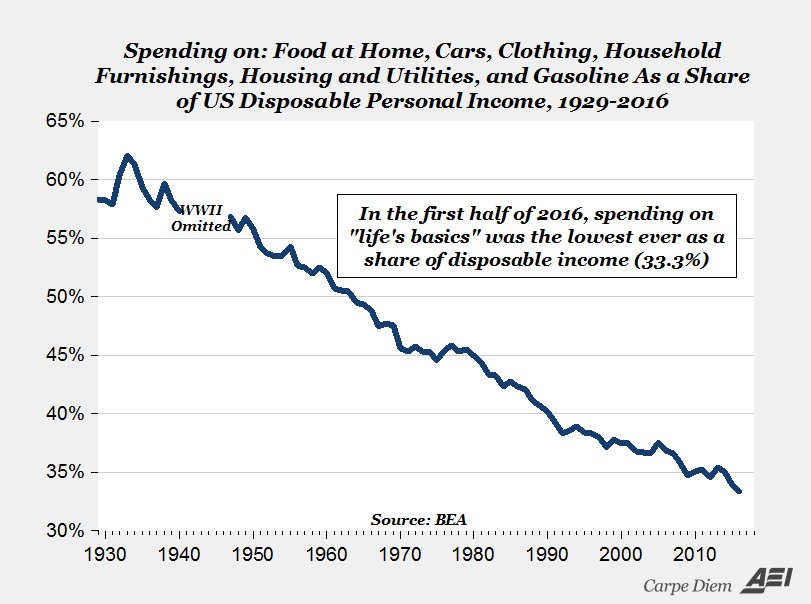
The chart above shows that household spending on “Life’s Basics” – food, clothing and shelter – has steadily declined over time as a share of after-tax personal income, from more than 50% in the 1930s and 1940s, to more than 40% for most of the 1970s when it took more than a week of work to buy a standard air conditioner, to only about 32% in recent years.

The gradual increase in our standard of living thanks to the falling prices (measured in both inflation-adjusted dollars and in the “time cost”) of appliances, food, clothing, cars and household appliances is an under-appreciated and under-reported benefit of the “miracle and magic of the marketplace.” 

As Larry Kudlow always reminds us “Free market capitalism is the best path to prosperity.”


Friday, September 18, 2015

VIDEO of the Week: "Is Capitalism Moral or Greedy?"


Is capitalism moral or greedy?
Posted by Dennis Prager on Monday, September 14, 2015

Tuesday, November 15, 2011

Quote of The Day: Why Large Corporation Are Sitting on Cash...


“Capital does not ask for raises. Capital does not unionize. Capital does not demand health care benefits.” 


- UBS economist on why many large corporations are sitting on cash instead of hiring


Monday, March 22, 2010

Socialism: Ayn Rand's Definition...


"Socialism is the doctrine that man has no right to exist for his own sake, that his life and his work do not belong to him, but belong to society, that the only justification of his existence is his service to society, and that society may dispose of him in any way it pleases for the sake of whatever it deems to be its own tribal, collective good."

- Ayn Rand


Sunday, March 21, 2010

Socialism vs. Capitalism: The Critical Distinction ...In A Nutshell

by John G. Harris

"Because Socialism Redistributes The Wealth That Capitalism Creates..."


...Socialism is NOT an Economic System.  

Socialism CANNOT create jobs, opportunity or wealth on its own. Instead Socialism confiscates the wealth that Capitalism creates in order to redistribute it. 

Capitalism, on the other hand, creates wealth and is therefore a viable Economic System which has, over time, increased living standards and the quality of life. 

Socialism, instead, is a POLITICAL System, NOT an Economic System because Socialism DOES NOT create an economic benefit in, of, or by itself. 

Instead 
Socialism serves as a parasite - by virtue of  Socialism's confiscation and redistribution of the wealth that Capitalism creates. 

Capitalism, which is rooted in liberty and freedom of choice, is Economically Motivated. 

Socialism, which can only succeed by engaging in the imposition of coercion, is Politically Motivated, serving as political tool to restrict freedom and concentrate power by force.

In sum, because it's a parasite, 
Socialism CANNOT subsist on its own - NOT without its host - Capitalism - which provides its sustenance.

"Parasitism
 is a type of symbiotic relationship between two different organisms. The parasite benefits from a prolonged, close association with the host, which is harmed."

Monday, December 28, 2009

WSJ - Government Now Rooted In The Economy - Bailout Mentality

In 2008 and 2009, Washington strove to save the economy.

In 2010, Americans will get a clearer picture of how Washington has changed the economy.


Only as the recession recedes will it become fully evident how permanently the state's role has expanded and whether, as a consequence, a new, hybrid strain of American capitalism is emerging.

One thing is clear: The government is a much bigger force in today's U.S. economy than it was before the financial crisis.

"The frontier between the state and market has shifted," says Daniel Yergin, whose 1998 book "Commanding Heights" chronicled the ascent of free-market forces starting in the 1980s. "The realm of the state has been enlarged."

Washington pumped $245 billion into nearly 700 banks and insurance companies, guaranteed almost $350 billion of bank debt, made short-term loans of more than $300 billion to blue-chip companies, propped up life insurers and money-market funds, bailed out two of the three U.S. auto makers, lent billions trying to jump-start commercial-real-estate, small-business and credit-card lending, and in two February stimulus bills enacted a year apart, committed $955 billion to rouse the economy.

Today the U.S. government, directly or indirectly, underwrites 9 of every 10 new residential mortgages, nearly twice the percentage before the crisis.

Just last week, the U.S. Treasury said it would cover an unlimited amount of losses at mortgage giants Fannie Mae and Freddie Mac through 2012.

John Taylor, a former Bush Treasury official who is now a Stanford University economist, says the government's role will be huge. "While we may be past the emergency, we're still in a mode that will create similar interventions for quite a while, even for minor emergencies," he says. "We have a bailout mentality in this country."

Even if the government withdraws, business will expect bailouts in the next crisis, and that will inspire another round of cavalier risk-taking.

"If we don't re-regulate the banking system properly, we'll either get very slow growth from overregulation, or another financial crisis in just 10 to 15 years," says Kenneth Rogoff, a Harvard University economist and co-author of a new book on financial crises since the Middle Ages.