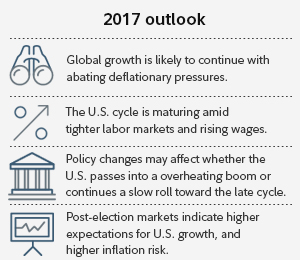
Showing posts with label global growth. Show all posts
Showing posts with label global growth. Show all posts
Wednesday, January 4, 2017


Wednesday, October 7, 2015
The Threat of Global Deflation...
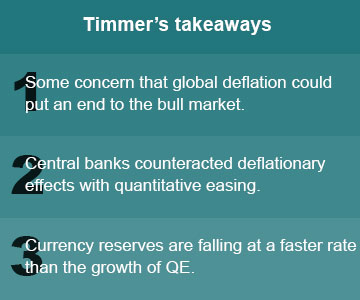
If the recent decline in global currency reserves is an adequate proxy for the forces of global deflation, then we are now possibly facing the most serious threat to the global bull market since it began in 2009. Central banks have a huge QE hurdle to overcome (more than $1 trillion).
I believe they will overcome it, thanks in part to the ECB and BoJ. But with the Fed missing in action from the QE battle (at least for now), let’s hope China doesn’t devalue its currency even more than it did in August, because that could drive emerging markets into a prolonged period of deflationary QT.
But then again, this is a dynamic game, so while a Fed lift-off and the lack of QE seem like a sure thing for now, that could change depending upon the gyrations of the global economy.
Friday, July 24, 2015
Global Growth is In Sync for the 1st Time in 5 Years!

Jeffrey Kleintop at Charles Schwab pointed out that based on GDP projections, 2015 is setting up to be the first time that the three biggest developed economies have all grown in a year since 2010.
While the US has steadily increased GDP since then, Japan and the Eurozone have traded off recessions in during the four years. Japan contracted in 2011 and 2014, while the Eurozone contracted in 2012 and 2013.
"While the U.S. Fed is withdrawing economic stimulus, the central banks of Europe and Japan are aggressively adding stimulus," Kleintop wrote. "This should help to sustain the economic recovery and support the stock market over the coming year."
Read more @:
Global Growth is In Sync for the 1st Time in 5 Years
Wednesday, February 4, 2015

Wednesday, August 17, 2011
Recession in the USA? Depends On The Global Economy's Big Three...
Turmoil Dampens Already Slowing Global Economy
The eurozone sovereign debt crisis has contributed to rising risk aversion in global credit markets. Even more fundamentally, the crisis has reinforced the increasingly weak outlook for European economic growth.
Europe accounts for roughly one-fifth of the global economy.
Weaker European demand will likely further damage already decelerating export growth in Asia and other regions.
China’s economy has moderated substantially in recent months amid significant monetary tightening. A slowdown in exports raises the near-term risks of a hard landing there.
Japan has been unable to fully regain its footing after its nuclear and natural disasters.
With Europe, China, and Japan accounting for 50% of non-U.S. economic activity, the world’s three largest economies outside the U.S. may be stalling.
Turmoil Dampens Already Slowing Global Economy
The eurozone sovereign debt crisis has contributed to rising risk aversion in global credit markets. Even more fundamentally, the crisis has reinforced the increasingly weak outlook for European economic growth.
Europe accounts for roughly one-fifth of the global economy.
Weaker European demand will likely further damage already decelerating export growth in Asia and other regions.
China’s economy has moderated substantially in recent months amid significant monetary tightening. A slowdown in exports raises the near-term risks of a hard landing there.
Japan has been unable to fully regain its footing after its nuclear and natural disasters.
With Europe, China, and Japan accounting for 50% of non-U.S. economic activity, the world’s three largest economies outside the U.S. may be stalling.
Europe accounts for roughly one-fifth of the global economy.
Weaker European demand will likely further damage already decelerating export growth in Asia and other regions.
China’s economy has moderated substantially in recent months amid significant monetary tightening. A slowdown in exports raises the near-term risks of a hard landing there.
Japan has been unable to fully regain its footing after its nuclear and natural disasters.
With Europe, China, and Japan accounting for 50% of non-U.S. economic activity, the world’s three largest economies outside the U.S. may be stalling.
Friday, August 20, 2010
Pimco's El-Erian: Investors Should Prep for 'Major Structural Changes'
Investors should prepare for “major structural changes” as the economy shifts to consistently slower global growth, according to Mohamed A. El-Erian, chief executive officer at Pacific Investment Management Co.
“Forget about being hostage to mindsets that are very cyclical and look broader, because there are some major structural changes -- there's some major realignment both at the national level and at the global level,” he said in a radio interview today on “Bloomberg Surveillance” with Tom Keene. “When you are on a bumpy journey to a new normal, the unthinkable and the improbable become probable.”
Global growth will be below average during the next 3 to 5 years as developed economies struggle with mounting deficits and increased regulation in the wake of the 2008 collapse of credit markets, according to Pimco.
“Forget about being hostage to mindsets that are very cyclical and look broader, because there are some major structural changes -- there's some major realignment both at the national level and at the global level,” he said in a radio interview today on “Bloomberg Surveillance” with Tom Keene. “When you are on a bumpy journey to a new normal, the unthinkable and the improbable become probable.”
Global growth will be below average during the next 3 to 5 years as developed economies struggle with mounting deficits and increased regulation in the wake of the 2008 collapse of credit markets, according to Pimco.
Pimco's investment strategy has been to shift to higher- quality assets and pursue investments in different parts of the world, El-Erian said.
The $234 billion Total Return Fund managed by Pimco co- founder Bill Gross has returned +13% the past year, beating 64% of its peers, according to data compiled by Bloomberg.
The Federal Reserve's decision to reinvest principal payments on mortgage holdings into Treasuries didn't assuage investor concern, and the central bank may not have the appropriate tools to address all of the economy's problems, according to El-Erian.
“We should not over-depend on the Fed,” he said. “The Fed does not have enough instruments for what we're looking at. You need other agencies to get involved. We're not getting any structural solutions.”
The Fed reversed plans on August 10 to exit from aggressive monetary stimulus and decided to keep its bond holdings level to support an economic recovery that it described as weaker than earlier anticipated. Central bankers adopted a $2.05 trillion floor for their securities portfolio, pivoting toward a quantitative target for monetary policy.
Pimco, which has been synonymous with bonds for almost 4 decades, in the past year has created an equity mutual fund and a unit to invest in hedge, real estate and buyout funds. Newport Beach, California-based Pimco has also started 10 exchange- traded funds.
The company, which managed more than $1.1 trillion of assets as of June 30, according to its website, is a unit of the Munich-based insurer Allianz SE.
Pimco's El-Erian: Investors Should Prep for 'Major Structural Changes'
Subscribe to:
Posts (Atom)