Showing posts with label global economy. Show all posts

Friday, February 17, 2017

Putting America's $18 Billion Economy in Global Perspective

usa2014


The map above was created by matching economic output in US states in 2014 to foreign countries with comparable nominal GDPs, using BEA data for GDP by U.S. state and GDP by country from the International Monetary Fund, via Wikipedia here

For each U.S. state (and the District of Columbia), Carpe Diem tried to find the country closest in economic size in 2014 (measured by nominal GDP), and for each state there was a country with a pretty close match – those countries are displayed in the map above and in the table below. 

Obviously, in some cases the closest match was a country that produced slightly more, or slightly less, economic output in 2014 than a given U.S. state.

It’s pretty amazing how ridiculously large the US economy is, and the map above helps put America’s GDP of nearly $18 trillion in 2014 into perspective by comparing the GDP of U.S. states to other country’s entire national GDP.


Wednesday, January 6, 2016

Fed Raises Rates: What’s Next?


In mid-December, the Federal Reserve announced the first rate hike in nearly 10 years. Here are four things to keep in mind.

1. The first rate hike usually indicates economic improvement, not an imminent market downturn.

It’s important to keep in mind the context of today’s action. Historically, the first Fed hikes have not precipitated economic or market downturns. Typically, the first rate increase has been a signal that the economy has gained traction, and on average, asset markets have typically performed relatively well in the year or two after the first hike.

2. This round of rate hikes may be gradual.

This round of rates hikes is starting as the Fed faces a far weaker backdrop for global growth—as well as much lower inflation—than is typical for the first rate hike in a cycle. This would seem to imply the Fed will move forward at a gradual pace of tightening. This weaker global and inflation environment makes a dramatic spike in interest rates less likely.

3. Higher rates could pressure commodities and emerging markets.

It is important to keep in mind that Fed monetary tightening does tighten global dollar liquidity as well. Because the dollar is the world’s reserve currency, this tighter liquidity has made it more difficult for many asset prices in recent months—including emerging-market equities, non-U.S. currencies, and commodity prices. These markets may remain volatile in the aftermath of the Fed’s first hike.

4. The economy could stabilize.

Finally, our outlook is that the global economy will digest the Fed hike over the coming months. The rate increase may even boost confidence in the U.S. economy by reassuring us all that we are finally on a path to normalization. And with the U.S. still in a steady mid-cycle expansion, we expect the global economy to stabilize over the course of 2016. Markets are likely to be choppy, but overall I think the outlook for equities should be relatively favorable as the year unfolds.

https://www.fidelity.com/viewpoints/market-and-economic-insights/fed-raises-rate?ccsource=email_weekly


© 2015 These presentations are provided for informational purposes only. Read relevant legal disclosures.

Wednesday, October 7, 2015

The Threat of Global Deflation...

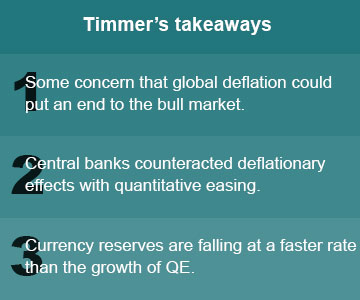
Timmer's takeaways


If the recent decline in global currency reserves is an adequate proxy for the forces of global deflation, then we are now possibly facing the most serious threat to the global bull market since it began in 2009. Central banks have a huge QE hurdle to overcome (more than $1 trillion).

I believe they will overcome it, thanks in part to the ECB and BoJ. But with the Fed missing in action from the QE battle (at least for now), let’s hope China doesn’t devalue its currency even more than it did in August, because that could drive emerging markets into a prolonged period of deflationary QT.

But then again, this is a dynamic game, so while a Fed lift-off and the lack of QE seem like a sure thing for now, that could change depending upon the gyrations of the global economy.


Friday, July 24, 2015

Global Growth is In Sync for the 1st Time in 5 Years!


cotd synchronized growth


Jeffrey Kleintop at Charles Schwab pointed out that based on GDP projections, 2015 is setting up to be the first time that the three biggest developed economies have all grown in a year since 2010.


While the US has steadily increased GDP since then, Japan and the Eurozone have traded off recessions in during the four years. Japan contracted in 2011 and 2014, while the Eurozone contracted in 2012 and 2013.

Kleintop notes that the long awaited synchronization is good news for investors.

"While the U.S. Fed is withdrawing economic stimulus, the central banks of Europe and Japan are aggressively adding stimulus," Kleintop wrote. "This should help to sustain the economic recovery and support the stock market over the coming year."

Read more @: 

Global Growth is In Sync for the 1st Time in 5 Years


Thursday, September 22, 2011

Bearish Omen for The Stock Market: Copper Drops to New Lows


Chart and article excerpts courtesy of Investors Business Daily

Copper, the so-called red metal with a Ph.D. in economics is used to gauge global activity because it's found in all facets of everyday life, from consumer electronics to building infrastructure. Like most commodities, copper has fallen amid the dollar's newfound strength the past month, owing to safe-haven buying spurred by the European debt crisis.

Tom McClellan, editor of the McClellan Market Report, wrote in his Sept. 16 newsletter that "copper's failure to rally along with the stock market suggests the market will likely give back its gains."

"The global economy is still quite weak, particularly here in the U.S.," said Bill Strazzullo, a partner and chief market strategist at Bell Curve Trading. "We believe you will see the S&P 500 trading around 1000 to 950 and the Dow at 9400 to 9000."

Read the entire Investor Business Daily report here...
Copper ETFs Hit New Low, A Bad Omen For Stocks


Tuesday, September 13, 2011

Global Recession Ahead? Crude Oil Says, "Not Yet!"...


When global markets collapsed in 2008, crude oil plunged for 7 consecutive months, crumbling from $147 per barrel in July 2008 and bottoming near $35 a barrel in February 2009. (See monthly crude oil chart above.)

Fast forward to September 2011 where we see crude oil trading near $90 a barrel. 

Bottom Line: 
If a severe global recession takes hold, expect crude oil, a harbinger for global growth, to plunge. So far, that hasn't happened, a positive for the global economy and global financial markets.

Keep a watchful eye on crude oil and copper for warning signs of a global recession.


Thursday, September 1, 2011

Quote of The Day: "The world economy is now in the grips of..."


"The world economy is now in the grips of a damaging feedback loop involving deteriorating fundamentals, lagging policy responses and destabilised financial markets.

If policymakers do not act boldly, and do so in a globally-coordinated fashion, the world risks tipping into a prolonged recession with worrisome institutional, political and social consequences."


Mohammed El-Erian, Pimco


Wednesday, August 17, 2011

Recession in the USA? Depends On The Global Economy's Big Three...


Turmoil Dampens Already Slowing Global Economy

The eurozone sovereign debt crisis has contributed to rising risk aversion in global credit markets. Even more fundamentally, the crisis has reinforced the increasingly weak outlook for European economic growth. 

Europe accounts for roughly one-fifth of the global economy. 

Weaker European demand will likely further damage already decelerating export growth in Asia and other regions.

China’s economy has moderated substantially in recent months amid significant monetary tightening. A slowdown in exports raises the near-term risks of a hard landing there. 


Japan has been unable to fully regain its footing after its nuclear and natural disasters.

With Europe, China, and Japan accounting for 50% of non-U.S. economic activity, the world’s three largest economies outside the U.S. may be stalling.