Showing posts with label loans. Show all posts

Thursday, July 13, 2017

Two Ways to Pay Off Your Debt and Student Loans Quickly


Pay It Back Fast: Make Extra Payments

The most straightforward way to pay off your outstanding debt or student loans faster is by making extra payments each month.

While your regular monthly payments go toward interest and your loan balance, extra payments are credited entirely against your outstanding balance. For example, if your regular payment is $100, $70 may pay interest costs while $30 is credited against your balance. Making an extra payment of $100 would decrease your balance by the full $100.

There’s one consideration, though: Talk to your lender to make sure that extra payments are applied the way you would like—they may not automatically be applied to the balance and instead be credited as prepayment of the next month unless otherwise noted.
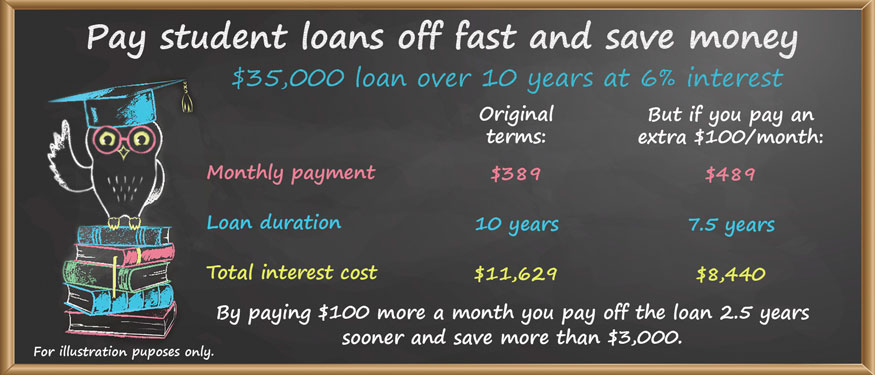
Pay student loans off fast and save money


Two Strategies for Extra Payments

Both of these strategies gather momentum as loans are paid off.

Snowball: Pay off the Lowest Balance First

Making extra payments on the smallest loan and paying it off can give you a psychological boost early on. Then apply the payment amount of that loan to the loan with the next-lowest balance. With an even higher extra payment, you begin to pay that one off quickly as well.


“While the snowball strategy may not be the most financially efficient, the emotional return of paying off smaller loans can give you the motivation and commitment to continue proactively paying down your debt,” says Mike Rusinak of Fidelity’s Financial Solutions research team.

Avalanche: Pay by Highest Interest Rate

The avalanche approach is the most financially efficient because the extra payment goes to the loan with the highest interest rate. For instance, $2,000 paid against a 6% loan saves an average $5.00 in interest per month until the loan is paid off; whereas the same $2,000 paid against a 3% loan saves only $2.50 per month—assuming a 10-year loan term.


Once you’ve paid the highest rate loan off, direct the money that would have gone to that loan to the loan with the next-highest interest rate.

The impact of extra payments may be slightly different depending on your repayment plan—if you are on any of the income-driven repayment plans, then extra payments are not as straightforward; the math is similar, but there are a lot more moving parts.


Friday, October 14, 2016

The Pros & Cons for Car Loans


guide_to_debt_carloans_head

Basics


Many people need a car; it’s a fact of life for most Americans. But cars are a depreciating asset.

Unlike a mortgage or a student loan, you’re not building any equity or making an investment in yourself.

Car loans can be found at banks, credit unions, and at car dealerships. Loan terms generally range from 25 to 84 months. The average new car loan term was 67 months at the end of 2015.


Friday, June 17, 2016

The Pros & Cons of Mortgage Debt


guide_to_debt_mortgage_head

Basics


Houses are generally the most expensive purchase most people will make. In order to swing it, most people take out a mortgage. There are a few different types to consider.

FHA loans: For first-time homebuyers with little savings, the Federal Housing Administration, or FHA, has a loan guarantee program that allows first-time homebuyers to buy a home with as little as 3% down. Borrowers do have to pay extra to have the loan guaranteed by the FHA.

VA loans: Similarly, the Veterans Administration (VA) guarantees loans to service members and eligible surviving spouses. Loans backed by the VA might not require a down payment if the sales price is equal to or less than the appraised value. No private mortgage insurance is required, as the VA insures the loan. Even if you have less-than-perfect credit, you can get a loan at competitive interest rates.


Wednesday, June 15, 2016

The Pros & Cons of Student Loans


guide_to_debt_studentloans_head

Basics


There are two types of lenders for student loans: Federal and Private.


Friday, November 20, 2015

Learn Liberty VIDEO of the Week: "Student Debt: Game of Loans"


New Video! "Game of Loans" with Charlie Kirk of Turning Point USAWhy does student debt keep going up and up even as it...
Posted by PragerU on Monday, November 9, 2015

Wednesday, February 17, 2010

Commercial Real Estate Is The Next Crisis

The Congressional Oversight Panel said in a report that mounting commercial real estate losses could endanger the banking system and thwart economic recovery.

A total of $1.4 trillion in commercial real estate loans will require refinancing in the next 4 years, and more than 50% of those loans are underwater, written for properties whose value has dropped like a rock.

The expected losses when loans go bad could hit between $200 billion to $300 billion and threaten 3,000 small and mid-size banks with a disproportionate share of commercial real estate assets on their books, according to the panel.

The report is intended to "wave a red flag" to the White House and Congress that the commercial real estate loan market is going to get a lot worse before it gets better.


"We're at a point where even as TARP is ramping down another major challenge in our economy is ramping up," said Elizabeth Warren, the oversight panel's chairwoman.

"We need to start now, before the system is on the brink of collapse to figure out a plan," she added.


The Panel's research found that 2,988 banks are heavily invested -- with more than 3 times their assets tied up -- in commercial real estate loans. Of that number, 2,500 banks each have less than $1 billion in assets.

The Panel offers a number of possible solutions for policymakers to head off a commercial real estate crisis, including stress tests for banks, injecting capital into these small banks, buying their toxic assets, or guaranteeing loans.


Friday, February 12, 2010

3,000 Banks Face Commercial Real Estate Risk

A new report from the Congressional Oversight Panel which tracks the progress of the TARP program projects that commercial real estate losses threaten nearly 3,000 mid-sized and small banks and may severely compromise their ability to make loans.

At the core of the report is the observation that “Between 2010 and 2014, about $1.4 trillion in commercial real estate loans will reach the end of their terms. Nearly 50% are at present "underwater”that is, the borrower owes more than the underlying property is currently worth.”

This means many of the banks which hold these loans have commercial real estate borrowers who will not be able to make interest and principal payments and cannot refinance their mortgages.

The Panel also points out that there have been NO “stress tests” of these smaller banks so the scope of their real financial problems is unknown.

The new analysis underscores the problems that the Obama Administration and Congress face as they attempt to increase the capital available to consumers and small businesses.

Banks are still unlikely to make all but the safest of loans because of current and anticipated problems with their balance sheets. The issue is exacerabated by the worry that modest-sized businesses are at greater risk of failure and therefore loan defaults in a slow economy.


The only practical solution to the problem for both banks and their current and potential customers is for the federal government to take money it does not have to bolster the balance sheets of the nearly 3,000 banks at risk for large commercial real estate write-offs.

Alternatively, these firms could be loaned money by the government to make money available to small business which need credit. That process might stimulate lending but would not solve the problem of the write-offs these financial institutions face.


The Treasury Department has said that the $700 billion TARP program is no longer necessary to rebuild the bank and credit systems.

It turns out that if the Congressional Oversight Panel forecasts are accurate, the Treasury’s observation is not even close to the truth.


Douglas A. McIntyre @ 24/7 Wall Street