Showing posts with label retirement. Show all posts
Showing posts with label retirement. Show all posts
Friday, May 26, 2017


Wednesday, May 24, 2017

Friday, May 19, 2017


Wednesday, May 17, 2017
Social Security: Breakeven Periods

In essence, as long as the divorcee believes he/she can survive to breakeven age, it’s beneficial to delay an ex-spouse’s spousal benefit. To the extent that the divorcee lives materially longer, inflation is higher and/or market returns are lower, the decision to delay will look even better.
Social Security Claiming Strategies for Divorcees | Financial Planning
Wednesday, May 10, 2017
Friday, May 5, 2017
Wednesday, May 3, 2017
Friday, February 10, 2017
Case Study: Managing Taxation on Retirement Income Withdrawals
Example: How to Manage Taxes on Withdrawals for Retirement Accounts.
This hypothetical example is for illustrative purposes only. This hypothetical scenario assumed the couple does not receive Social Security benefits. Social Security income would further complicate the tax scenario described above and should be considered when creating a withdrawal strategy.
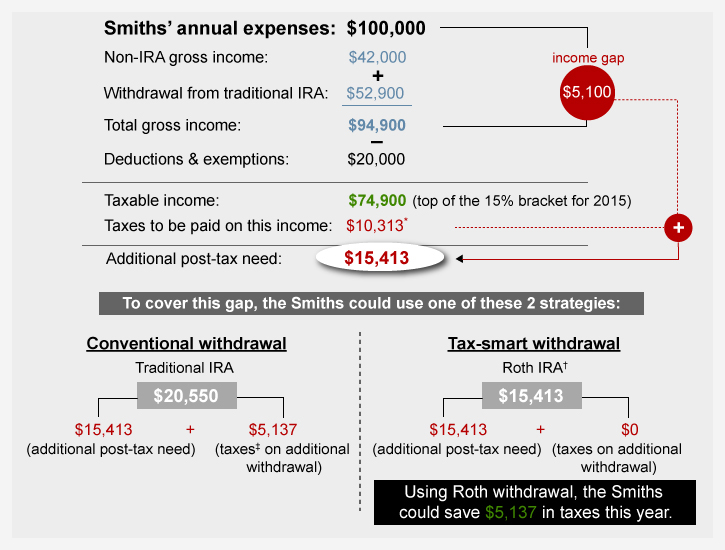
As a way to help minimize the taxes you’ll pay, consider the following hypothetical scenario. It illustrates the way a retired married couple whose annual expenses total $100,000 might seek to manage their taxes.
Our hypothetical couple expects $42,000 in gross income (all taxable) before tapping their retirement accounts, so their gross income gap—(before considering taxes)—is $58,000. They anticipate $20,000 in deductions and exemptions, so their expected taxable income before withdrawals is $22,000. If they withdraw $52,900 from their traditional IRAs, it would bring their taxable income to $74,900—the top of the 15% bracket. They could then withdraw the remaining $5,100 that they need to cover their income gap from a Roth IRA, which does not generate taxable income (assuming the withdrawal is qualified). The chart (above) shows their cash flow and taxable income.
Our hypothetical couple expects $42,000 in gross income (all taxable) before tapping their retirement accounts, so their gross income gap—(before considering taxes)—is $58,000. They anticipate $20,000 in deductions and exemptions, so their expected taxable income before withdrawals is $22,000. If they withdraw $52,900 from their traditional IRAs, it would bring their taxable income to $74,900—the top of the 15% bracket. They could then withdraw the remaining $5,100 that they need to cover their income gap from a Roth IRA, which does not generate taxable income (assuming the withdrawal is qualified). The chart (above) shows their cash flow and taxable income.
Other Options for Our Hypothetical Couple
The hypothetical couple in this scenario leaves the bulk of Roth IRA assets alone, leaving them in place to potentially generate tax-free growth. In certain situations, however, it may be advantageous to tap Roth assets instead of tax-deferred or taxable accounts. These include situations when:
- Any distributions at all from a tax-deferred account would cause your taxable income to exceed your target marginal tax rate
- Withdrawing from a taxable account would require selling assets held less than a year, resulting in short-term capital gains, which are taxed at ordinary income tax rates
- You are also trying to minimize taxes on Social Security benefits, withdrawals from a tax-deferred account would have an impact on the taxability of those benefits
Your circumstances may be considerably different from those described in the scenario. Nevertheless, you may be able to apply the principles to your own situation. A tax professional can help you explore the implications of different withdrawal strategies, help minimize the amount of taxes you pay on hard-earned savings, and, of course, help you maximize your ability to live the retirement you envision.
Wednesday, February 8, 2017
How Life Expectancy Is Reshaping Retirement Planning...
How rapidly has longevity changed, and how has that shift affected society?
Life was short.
By the mid-1800s life expectancy had reached the mid-30s in the United States, and in 1900 it was 47 years.
By the end of the century, life expectancy had reached 77 years. By the mid-1800s life expectancy had reached the mid-30s in the United States, and in 1900 it was 47 years.
It gained 30 years in one century—that’s unprecedented.
More years were added to average life expectancy in the 20th century than all the years added in all prior millennia of human evolution combined!
Most of the gains in the first half of the century resulted from reducing childhood mortality, but since 1950 life expectancy at 65 has been rising as well. In fact, life expectancy has increased by about three months a year for some time.
Most people are thinking about growth in longevity in terms of an aging population’s burden on society. But I think we have the opportunity to look at it another way— to reshape current models so that we live decades longer than our ancestors in a way that improves quality of life at all ages.
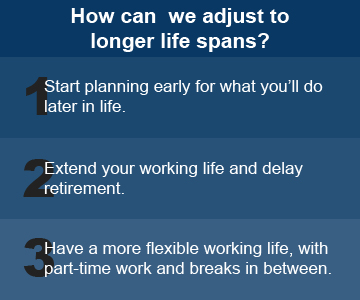
How might we reshape our understanding of retirement to suit longer lives?
We’re going to completely redefine retirement or get rid of the concept altogether. The old model just won’t work anymore. Most people can’t save enough in 40 years of working to support themselves for 30 or more years of not working. Nor can society provide enough in terms of pensions to support nonworking people that long.
Wednesday, January 25, 2017

Friday, December 30, 2016
The Percentage of Americans Participating in Encore Careers Might Surprise You...
Percentage of People Earning a Salary or Volunteering in Encore Careers
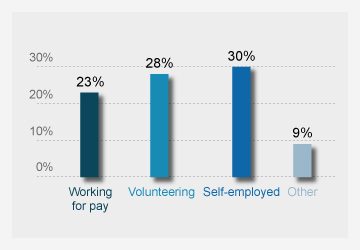
Source: Encore.org, 2014. Amounts that don’t add to 100% were either from people whose response was “don’t know” or, in some cases, it was due to rounding. Working for pay refers to people who were earning a wage or a salary. Self-employed refers to people who were working in for-profit businesses, such as entrepreneurs.
Wednesday, December 21, 2016
Friday, December 9, 2016
Wednesday, November 16, 2016

Friday, November 4, 2016
Wednesday, October 12, 2016

Wednesday, October 5, 2016
Friday, July 15, 2016
Friday, July 8, 2016
Subscribe to:
Posts (Atom)