Showing posts with label income tax. Show all posts
Showing posts with label income tax. Show all posts
Wednesday, June 21, 2017
The Top 0.1% Pay 23.5% of all Federal Income Taxes
TWO OUT OF THREE - 64% of all individual tax returns filed in 2012 (92.9 million returns out of 144.9 million returns filed) reported less than $50,000 of adjusted gross income.
(source: Internal Revenue Service).
THE REALLY RICH - The Top 0.1% of U.S. taxpayers (the Top 1 out of every 1,000 taxpayers) is estimated to pay 23.5% of all Federal income tax for the 2014 tax year
(source: Tax Policy Center).
Who's not paying their fair share?


Friday, January 27, 2017
Tips for Deducting More at Tax Time
Tax Deductions come in two basic types:
“Above-the-Line” and “Below-the-Line.”
The “Line” is your Adjusted Gross Income, or AGI.
Above-the-Line deductions are subtracted from your total income, thus lowering your AGI.
Another advantage is that many “Above-the-Line” deductions are allowed under the Alternative Minimum Tax, or AMT.
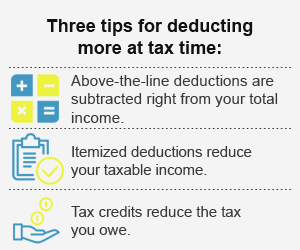
A lower AGI can potentially increase the value of your Below-the-Line itemized deductions, which often come with limits.
For example, you can deduct your medical and dental expenses, but only the amount that exceeds 10% of your AGI (7.5% if you or your spouse is 65 or older) and only if you itemize deductions on your federal tax return.
So the lower your AGI, the quicker you hit 10% and can start deducting.
You can’t claim these expenses if you take the standard deduction which, for 2016, is $6,300 for taxpayers who are single or married filing separately, $12,600 for married filing jointly, and $9,300 for heads of household (single taxpayers with dependents).
Wednesday, August 24, 2016
Wednesday, January 13, 2016
.jpg)
Friday, November 27, 2015
Learn Liberty VIDEO of the Week: "Don't Higher Tax Rates Always Result in Higher Tax Revenues?"
Do higher tax rates result in higher tax revenues? Not always. #LearnLibertyClassic
Posted by Learn Liberty on Monday, November 23, 2015
Wednesday, November 4, 2015
 F
F
Friday, April 25, 2014
Increasing Tax Rates Does Not Necessarily Lead to Higher Income Tax Receipts
Tax cuts can create incentives for individuals to work, save, and invest, which can generate more revenue.
The most dramatic decline in the top individual income tax rate, from 70 percent to 28 percent, occurred during the Reagan Administration, during which tax receipts remained relatively constant as a share of the economy.
The most dramatic decline in the top individual income tax rate, from 70 percent to 28 percent, occurred during the Reagan Administration, during which tax receipts remained relatively constant as a share of the economy.
PERCENTAGE OF GDP

Friday, December 27, 2013
Adjusted for Inflation, Taxes per Household Have Risen Dramatically
Though the economic downturn has temporarily lowered overall tax revenues, the tax burden on Americans is twice what it was in 1965!
INFLATION-ADJUSTED DOLLARS (2011)

Friday, December 13, 2013
U.S. Has the Highest Corporate Tax Rate
High federal and state corporate tax rates make it difficult for U.S. headquartered businesses to compete internationally.
U.S. rates have been consistently higher than the average of industrialized nations.
In April 2012, Japan reduced its corporate tax rate to 36.8 percent, making the U.S. total corporate tax rate the highest.
U.S. rates have been consistently higher than the average of industrialized nations.
In April 2012, Japan reduced its corporate tax rate to 36.8 percent, making the U.S. total corporate tax rate the highest.
COMBINED CORPORATE TAX RATES

Wednesday, July 17, 2013

Wednesday, June 19, 2013

Thursday, April 18, 2013
Why Taxing the Wealthy to Balance the Budget Will Not Work...
CURRENT TAX RATES AND TAX RATES NECESSARY TO CLOSE DEFICIT

Sources: Internal Revenue Service and Congressional Budget Office (Alternative Fiscal Scenario).
Some argue for taxing the wealthy to reduce federal deficits. However, hiking taxes on taxpayers in the two highest brackets would increase their tax rates to mathematically impossible levels.
To close the 2035 deficit, the top two tax rates would increase to 159% and 166%, and in 2050 they would reach 236% and 246%.
Thursday, March 14, 2013
Who's Not Paying Their Fair Share? Nearly Half of All Americans!...

“The percentage of people who DO NOT pay federal income taxes, and who are not claimed as dependents by someone who does pay them, jumped from 14.8% in 1984 to 49.5% in 2009.”
- The Heritage Foundation
Friday, March 1, 2013
40% of U.S. Households Pay 86% of All Federal Taxes...

40% of U.S. households paid 86.2% of all federal taxes — personal, corporate, Social Security and excise — in 2009, according to the Congressional Budget Office.
That leaves 60% of the nearly 118 million U.S. households — the majority of the country — paying only 13.8%.
Wednesday, February 27, 2013

Tuesday, August 21, 2012

Friday, August 3, 2012
Rich Pay Their Fair Share Of Taxes—And Then Some...

Chart Courtesy of Investors Business Daily. Full article Link...
Rich Pay Their Fair Share Of Taxes—And Then Some...
Wednesday, July 25, 2012

Tuesday, September 27, 2011
Tax Returns With Zero Or Negative Federal Tax Liability Reaches Soars to 47%!

"Too many takers — not enough givers."
Wednesday, April 20, 2011
Who Pays Income Tax? How Much? And Is Everyone Paying Their Fair Share?

The Bottom 50% of earners pay almost nothing, and the Top 1% pay close to 40% of the income tax collected.
The Bottom 90%, which in 2008 included all returns with adjusted gross income of up to $114,000, were paying 30%, down from 44% in 1987.
The Bottom 90%, which in 2008 included all returns with adjusted gross income of up to $114,000, were paying 30%, down from 44% in 1987.
That means that the Top 10% pay a whopping 70%!!!
Are the Bottom 90%, at only 30%, paying their fair share?
Very high incomes are produced not so much by wages and salaries but by capital gains and bonuses, which rise and fall with booms and busts.
In good years, the government gets a windfall and can't resist the urge to take on new spending commitments. In bad years, revenues collapse, but the spending can't be so easily rolled back.
Are the Bottom 90%, at only 30%, paying their fair share?
Very high incomes are produced not so much by wages and salaries but by capital gains and bonuses, which rise and fall with booms and busts.
In good years, the government gets a windfall and can't resist the urge to take on new spending commitments. In bad years, revenues collapse, but the spending can't be so easily rolled back.
As the tax system has grown more top-heavy, its revenues have also grown more volatile. The income-tax take spiked to an all-time high in 2000, hitting 10% of GDP for the first time ever. In 2010, it sank to 6.2%, its lowest level in more than 50 years.
Source: IRS and Investors Business Daily
Subscribe to:
Posts (Atom)