Showing posts with label tax. Show all posts
Showing posts with label tax. Show all posts
Wednesday, May 3, 2017


Friday, February 10, 2017
Case Study: Managing Taxation on Retirement Income Withdrawals
Example: How to Manage Taxes on Withdrawals for Retirement Accounts.
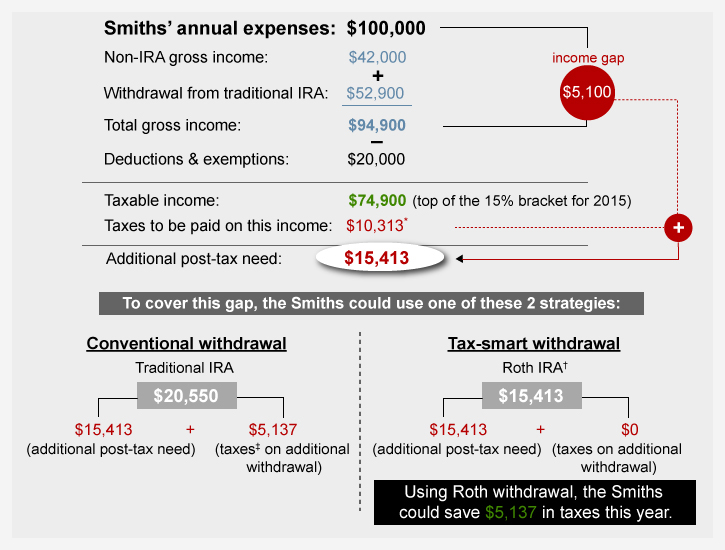
This hypothetical example is for illustrative purposes only. This hypothetical scenario assumed the couple does not receive Social Security benefits. Social Security income would further complicate the tax scenario described above and should be considered when creating a withdrawal strategy.
As a way to help minimize the taxes you’ll pay, consider the following hypothetical scenario. It illustrates the way a retired married couple whose annual expenses total $100,000 might seek to manage their taxes.
Our hypothetical couple expects $42,000 in gross income (all taxable) before tapping their retirement accounts, so their gross income gap—(before considering taxes)—is $58,000. They anticipate $20,000 in deductions and exemptions, so their expected taxable income before withdrawals is $22,000. If they withdraw $52,900 from their traditional IRAs, it would bring their taxable income to $74,900—the top of the 15% bracket. They could then withdraw the remaining $5,100 that they need to cover their income gap from a Roth IRA, which does not generate taxable income (assuming the withdrawal is qualified). The chart (above) shows their cash flow and taxable income.
Our hypothetical couple expects $42,000 in gross income (all taxable) before tapping their retirement accounts, so their gross income gap—(before considering taxes)—is $58,000. They anticipate $20,000 in deductions and exemptions, so their expected taxable income before withdrawals is $22,000. If they withdraw $52,900 from their traditional IRAs, it would bring their taxable income to $74,900—the top of the 15% bracket. They could then withdraw the remaining $5,100 that they need to cover their income gap from a Roth IRA, which does not generate taxable income (assuming the withdrawal is qualified). The chart (above) shows their cash flow and taxable income.
Other Options for Our Hypothetical Couple
The hypothetical couple in this scenario leaves the bulk of Roth IRA assets alone, leaving them in place to potentially generate tax-free growth. In certain situations, however, it may be advantageous to tap Roth assets instead of tax-deferred or taxable accounts. These include situations when:
- Any distributions at all from a tax-deferred account would cause your taxable income to exceed your target marginal tax rate
- Withdrawing from a taxable account would require selling assets held less than a year, resulting in short-term capital gains, which are taxed at ordinary income tax rates
- You are also trying to minimize taxes on Social Security benefits, withdrawals from a tax-deferred account would have an impact on the taxability of those benefits
Your circumstances may be considerably different from those described in the scenario. Nevertheless, you may be able to apply the principles to your own situation. A tax professional can help you explore the implications of different withdrawal strategies, help minimize the amount of taxes you pay on hard-earned savings, and, of course, help you maximize your ability to live the retirement you envision.
Friday, June 10, 2016
Thursday, June 2, 2016

Wednesday, January 13, 2016
.jpg)
Friday, November 27, 2015
Learn Liberty VIDEO of the Week: "Don't Higher Tax Rates Always Result in Higher Tax Revenues?"
Do higher tax rates result in higher tax revenues? Not always. #LearnLibertyClassic
Posted by Learn Liberty on Monday, November 23, 2015
Wednesday, September 9, 2015
Wednesday, June 24, 2015
Friday, March 21, 2014

Thursday, April 11, 2013

Friday, March 1, 2013
40% of U.S. Households Pay 86% of All Federal Taxes...

40% of U.S. households paid 86.2% of all federal taxes — personal, corporate, Social Security and excise — in 2009, according to the Congressional Budget Office.
That leaves 60% of the nearly 118 million U.S. households — the majority of the country — paying only 13.8%.
Wednesday, February 27, 2013

Thursday, July 5, 2012
Cartoon of The Day: Health Care Mandate: A Penalty? A Tax?

How can it be a "penalty" and a "tax" and neither -- all at the same time?
Friday, April 15, 2011
The Tax Code Is A Drag...for Taxpayers and on the Economy

This year, it will take the average taxpayer 23 hours just to fill out Form 1040 — up from 21 hours last year, according to the IRS. It now takes 7 hours to fill out the so-called 1040 EZ.
Tax complexity isn't merely a hassle for taxpayers, it's a huge drag on the economy. It takes more than 6 billion hours — or $163 billion a year — for companies and individuals to figure out what they owe, the IRS says. And the Government Accountability Office estimates that the distortions and inefficiencies created by the complex tax code cause up to $733 billion in "dead weight losses." Together, these costs equal 6% of GDP.
The ornate tax code also makes compliance harder and cheating easier, contributing to what the IRS figures is more than $290 billion in unpaid taxes — effectively raising taxes that much more on everyone else.
To get a sense of just how mind-bogglingly complex the federal tax code is, consider:
• More than 80% of individuals hire someone or buy software to help file their taxes, though only 64% of filers owe them, according to the Tax Foundation. So millions of filers pay for help to learn that their tax liability is zero.
• About two-thirds of low-income filers pay to have their taxes done, the Tax Policy Center found.
• The tax code has at least 6 definitions of a child, more than a 12 different education-related tax breaks and at least 16 different kinds of tax-favored savings plans.
Thursday, January 13, 2011
Is Everyone Paying Their Fair Share?
Americans filed 140 million tax returns for calendar year 2008 income.
Through the use of deductions, exemptions and credits, 52 million tax returns of the 140 million total returns (or 37% of all returns filed) paid zero federal income tax.
Source: Internal Revenue Service
Tuesday, November 30, 2010
Thursday, August 12, 2010
How the New Wealth Taxes Will Punish You - WSJ.com
The health-care bill that Congress passed in March contained two surprising new taxes to help pay for the changes: an extra 0.9% levy on wages for couples earning more than $250,000 ($200,000 for singles) and a new 3.8% tax on investment income on those same people (technically, people with "adjusted gross incomes" above those amounts).
Each tax signals a radical change in tax policy.
For workers, the extra 0.9% levy puts a progressive element in what used to be a totally flat tax.
The 3.8% tax on investment income also knocks down a longstanding wall by applying a "payroll" tax to unearned income.
Until now, FICA taxes for Social Security and Medicare have applied only to wages, not investment income.
Read more here...
How the New Wealth Taxes Will Hit You - WSJ.com
Each tax signals a radical change in tax policy.
For workers, the extra 0.9% levy puts a progressive element in what used to be a totally flat tax.
The 3.8% tax on investment income also knocks down a longstanding wall by applying a "payroll" tax to unearned income.
Until now, FICA taxes for Social Security and Medicare have applied only to wages, not investment income.
Read more here...
How the New Wealth Taxes Will Hit You - WSJ.com
Friday, June 25, 2010
An Intractable Fiscal Problem - by David Rosenberg (The Massive, Snowballing Debt Bulge)
An Intractable Fiscal Problem
by David Rosenberg
Even with low interest rates, the massive debt bulge has become so large that interest charges on the public debt are within 3 years of absorbing over 30% of the revenue base, which then makes it that much tougher to reverse course.
In other words, the fiscal problem is becoming increasingly structural and we are already at the stage where even if the economy were running flat out at full employment, the deficit would still be over 7% relative to GDP. At some point, this will begin to impede economic progress.
When you add up the entitlement programs, you know — the ones you can’t cut back on, and interest payments on the grotesque debt load, we have 65% of total government spending that can’t be touched.
In the next decade, under status quo policies, this “mandatory” share of the spending pie goes to 72%. Tack on the defense budget, my friends, and we are up to 88% of federal government outlays that are next to impossible to reverse.
So tell me — we are going to reverse this seemingly intractable run up in the public debt to GDP ratio by slicing 12% of the spending pie that is discretionary? It won’t be enough, even if all that 12% remainder ‘pork and barrel’ spending were eliminated altogether.
So guess what the future holds … higher taxes: very likely a national sales tax. It works in Europe. It has also worked in Canada. Japan is planning to double its national sales tax from 5% to deal with its fiscal challenge.
It stands to reason that a federal consumption tax will have to be part and parcel of any U.S. strategy to solve what is increasingly becoming an intractable budgetary deficit.
Indeed, while many a Keynesian will point to the need for a government-led demand boost, the problem is that when the deficits and debts become structural, what is known as the “Ricardian Equivalence” sets in and this means that the fiscal stimulus does more harm than good for the economy.
Unfortunately, while the bailouts saved insolvent banks (oh, we’re not Japan at all) the stimulus from this Administration involved a series of short-term quick fixes that provided no long-term multiplier impact. At least FDR put people to work — not merely to pay them to be idle. At least Eisenhower built highways -- with a long-run payback.
Read the entire article here...
Thursday, June 24, 2010
The Value Added Tax (VAT)...Is It Coming to America?
The "Value Added Tax."
In its simplest form, a VAT is a tax on the creation of value. At each stage of producing a product, from raw materials to fabrication, to assembly, to packing and shipping, each company is responsible for paying a tax on the value it adds.
As the VAT is always included in the retail prices, and consumers never have to pay more at the cash register, the tax increase would be hidden. In fact, consumers would no longer see a sales tax at the cash register. While that stealth will make a VAT seem "painless" to many, it is also what makes it so dangerous.
Most European countries introduced the VAT at rates around 10% and quickly raised it to the upper teens. Today most European countries have rates around 20% (the only notable exception is Luxembourg at 15%).
Country | Year Introduced | Initial Rate | Current Rate |
1967 | 10% | 25% | |
1968 | 10% | 19% | |
1986 | 12% | 18% | |
1954 | 18% | 20% | |
1972 | 16% | 21% | |
1973 | 12% | 20% | |
Luxemburg | 1970 | 8% | 15% |
1969 | 12% | 19% | |
1969 | 11% | 25% | |
1973 | 10% | 18% |
VAT rates have commonly been increased with hardly a whisper from the media. And they don't always go up in incremental single percentage points. Many European countries have raised rates 3% or 4% in one single year. In the case of
Sunday, May 16, 2010
Quote of The Day: High Tax Rates & Prosperity
"Higher tax rates don't produce prosperity or balanced budgets—as we can see in New Jersey and New York, or Greece and Portugal."
~ WSJ Editorial
Subscribe to:
Posts (Atom)