Showing posts with label planning. Show all posts

Wednesday, February 8, 2017

How Life Expectancy Is Reshaping Retirement Planning...


How rapidly has longevity changed, and how has that shift affected society?


Life was short. 

By the mid-1800s life expectancy had reached the mid-30s in the United States, and in 1900 it was 47 years
By the end of the century, life expectancy had reached 77 years
It gained 30 years in one century—that’s unprecedented. 
More years were added to average life expectancy in the 20th century than all the years added in all prior millennia of human evolution combined!
Most of the gains in the first half of the century resulted from reducing childhood mortality, but since 1950 life expectancy at 65 has been rising as well. In fact, life expectancy has increased by about three months a year for some time.
Most people are thinking about growth in longevity in terms of an aging population’s burden on society. But I think we have the opportunity to look at it another way— to reshape current models so that we live decades longer than our ancestors in a way that improves quality of life at all ages.

How might we reshape our understanding of retirement to suit longer lives?


We’re going to completely redefine retirement or get rid of the concept altogether. The old model just won’t work anymore. Most people can’t save enough in 40 years of working to support themselves for 30 or more years of not working. Nor can society provide enough in terms of pensions to support nonworking people that long. 
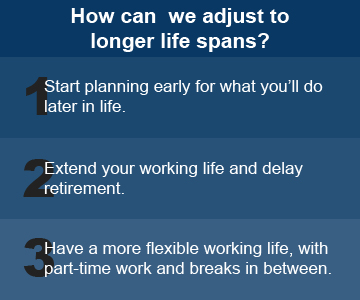
How can  we adjust to longer life spans?

Thursday, June 23, 2011

Majority of Pre-Retirees Have Saved Less Than $100,000 for Retirement...

63% — Percentage of pre-retirees who said they did NOT feel confident they will be able to live the retirement lifestyle they would like.

55%
— Percentage of retirees who have NOT saved enough for retirement — less than $100,000 in household financial assets.

30 million
— Number of pre-retirees who have considered the implications of outliving their income.

LIMRA
research found almost two-thirds of pre-retiree households, age 55-70, do NOT have a professional financial advisor. However, the majority, 54%, of those who DO work with an advisor feel confident about life after retirement.

“With so much uncertainty in the economy and in the social programs supporting retired Americans, pre-retirees face many challenges when preparing for retirement,” said Marie Rice, corporate vice president and director of LIMRA Retirement Research.

“Our research is clear: Those who use professional financial advisors enjoy the peace of mind that they are making the appropriate decisions to ensure they have a financially secure retirement.”

“Retirement planning involves many complicated decisions that should not be done without the knowledge and expertise that a professional financial advisor can provide,” commented Rice.

“Pre-retirees who use this help to make these critical decisions are more confident that they made the right choices.”


Source: LIMRA

Friday, June 18, 2010

10 Estate Planning Success Tips

10 Estate Planning Success Tips


While our representatives continue to talk about the repeal of estate taxes, there is still a federal estate tax in effect. The threshold for imposing this tax was raised to $1 million per person for people dying in 2003, and the estate tax is scheduled to disappear for only one year - 2010. In 2011, the estate tax is scheduled to reappear, so continue to take the following recommended actions in protecting your assets!


  1. Keep your will or trust up to date. Many state laws invalidate any will made prior to a major life event, such as marriage, divorce, moving to a new state, or the birth or adoption of a child. Keep your legal residence address, marriage status, beneficiaries list, etc. updated.

  2. Keep track of beneficiaries for all of your IRAs, qualified plans and insurance policies. Do you know who your beneficiaries are for these assets? If you don’t, they may be going to someone you no longer wish to receive them. You can easily change the name of the person who will receive their benefits by filling out a form.

  3. Maximize the liquidity of your estate. Liquidity is defined as the ability to quickly turn assets into cash. Without sufficient cash to pay taxes, funeral, and other expenses, your family may have to sell illiquid assets - such as a family business or other property - at an inopportune time. Avoid putting your family in the position of selling off the estate in a hurry by providing for sufficient liquidity.

  4. Maintain an Appropriate Mix of Investment Risk. It’s detrimental to have too much money allocated to risk in stocks or mutual funds, as a percentage of total cash assets and age. Over time, more risky investments should be moved into safe and stable investments such as Annuities.

  5. Name a dependable executor and/or trustee. Executors are called upon to collect assets, pay obligations, and distribute your assets. Your trustee must enforce all the provisions of any trusts you created. Choose people who have the knowledge, integrity and stamina in the face of pressure from family members to fulfill these obligations.

  6. Explore the ramifications of joint asset ownership with your spouse. This ties in with the estate tax issues in item 1: if your joint net worth exceeds $1 million, you might want to consider owning some assets separately as part of your overall estate plan.

  7. If you have minor children, consider naming one guardian for your minor children and a separate guardian for the property you've left to support them. The best guardian for your children may not be the most effective money manager you know. Just be aware that the person you've chosen as guardian of your children, can be a different person than the guardian that manages your children’s property.

  8. Estate planning for your spouse or other sole survivor scenarios. If your net worth is high enough, your estate may be subject to taxes. A simple estate plan can save some individuals hundreds of thousands of dollars in estate taxes.

  9. Leaving the right assets to the right people. If your child was a "special needs" child, you would not leave him money to handle on his own. Make sure your teenager or other dependents, receive much needed management along with the cash.

  10. Plan, Plan, Plan. The future is in your control. Decisions you make about how you structure your estate will affect your family. Until you’ve taken action, you don’t have an estate plan, but don’t be overwhelmed. Nothing is irreversible, and you can take small steps to put your plan into place. Planning is most important for business owners, who must plan for the succession and/or buy-out of their business. 

Tuesday, December 8, 2009

Four Common Retirement Mistakes

by Danielle Andrus @ Senior Market Advisor

Retirement planning encompasses more than just securing an income for your clients after they stop working; health care and estate planning are major parts of the retirement equation.

The Wall Street Journal recently outlined four common mistakes financial advisors are seeing their clients make that could spell disaster for their already precarious retirements. As the paper points out, retirement planning encompasses more than just securing an income for your clients after they stop working; health care and estate planning are major parts of the retirement equation. 

  1. Putting too much faith in bonds. Massive losses on stocks have made many retirees hesitant to stay invested in them; instead they opt for bonds, but the Journal offers a warning. Lawrence Glazer, of Boston-based Mayflower Advisors, told the paper, “It's a fallacy to think you can't lose money in bonds.” Credit risk, splendidly exemplified by Lehman Brothers last year, is a major concern. Likewise, low interest rates can lead retirees to reach for longer maturities and greater risk.

  2. Overspending. Your clients need a realistic spending budget, as well as a sustainable withdrawal rate, the paper writes. They also need to factor in rising health care costs and inflation. Another variable that is often overlooked by retirees is unexpected big expenses or big investment losses. As the past year has demonstrated, a back-up plan for sudden market losses is an important part of your clients’ retirement plans.

  3. Not maintaining their legacy. A will does not necessarily guarantee your clients’ assets will go to the people they want them to, although many people assume it’s sufficient, New York attorney Philip Bouklas told the paper. Your clients should have, and regularly update, a will, health care proxy and beneficiaries on their retirement accounts.

  4. Not broaching the subject. No one likes to talk about their own mortality, but it’s important for your clients to have a plan for what will happen to their assets after their death, or if they’re incapacitated due to an illness or disability.