Showing posts with label estate. Show all posts
Showing posts with label estate. Show all posts
Wednesday, May 3, 2017


Friday, April 28, 2017
Can Life Insurance Help Your Estate Plan?
Ben Franklin said that in
this world nothing is certain but death and taxes. Well, one product sits at
the intersection of both—life insurance. It may not help you cheat death, but
it may help manage taxes.
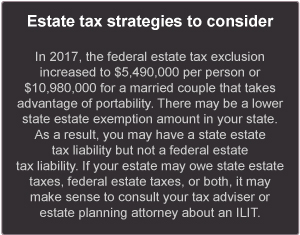
There are certain estate planning steps we should all take, including the creation of a will and a health care directive. But if you have enough wealth that you expect your estate to be taxed—at either the state or the federal level—you may want to consider more advanced strategies, including using life insurance in a trust.
Irrevocable Life Insurance Trust
✔ May provide cash for heirs to settle estate.
✔ Death benefit is generally not considered taxable income by the IRS.
✔ Choose an insurer with a strong rating.
✔ It is a complex legal arrangement requiring properly drafted documentation.
✔ Consult a legal advisor regarding your specific situation.
https://www.fidelity.com/viewpoints/personal-finance/can-life-insurance-help
Wednesday, April 26, 2017
Advantages and Disadvantages of Joint Ownership of Estates (with Definitions)
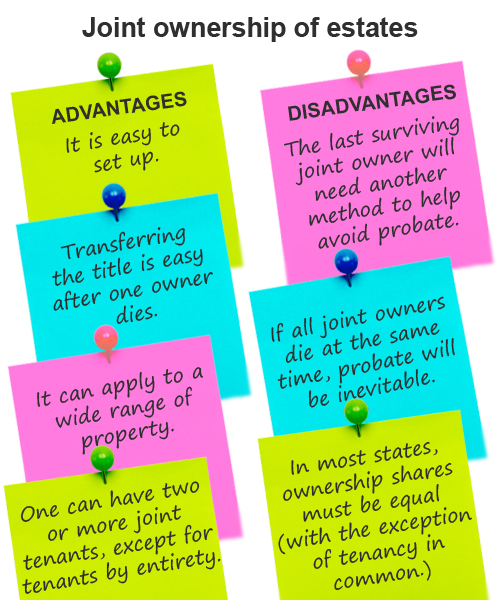
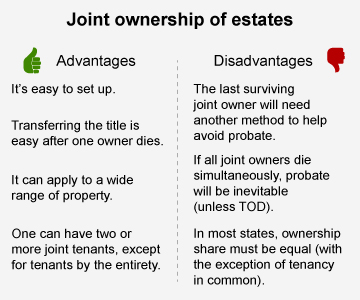
Joint ownership itself may be structured in different ways, which may affect an estate plan. Each type of joint ownership structure offers an undivided right to the use and enjoyment of the property. However, depending on the specific classification of joint ownership, the ultimate consequences of transfer at a joint owner’s death may vary.
There are three basic ways to title a joint account, and each of them has distinct implications for estate planning, depending on your situation.
Joint Tenancy with Rights of Survivorship: When one owner dies, property ownership transfers to the surviving owner(s) through the rights of survivorship. Probate may be avoided on the death of the first joint owner of a jointly held account but not necessarily on the death of the surviving joint owner. This is because the asset that was originally jointly held may now be titled solely in the name of the surviving joint owner, hence resulting in a potential probate on the death of the surviving joint owner unless measures are taken to avoid that result.
Tenancy by Entirety: This is similar to joint tenancy with rights of survivorship, except that it applies only to married couples, which would include married same-sex couples in some states.
Tenancy in Common: Unlike joint tenancy with rights of survivorship, with tenancy in common, when a joint owner dies, that owner’s interest in the property will become part of the deceased owner’s estate and will be passed on according to his or her will. A word of caution: Be careful establishing a tenancy in common account, because it will likely lead to probate issues.
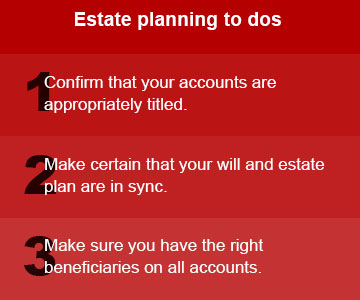
https://www.fidelity.com/viewpoints/estate-planning-to-dos
Friday, April 21, 2017
Estate Planning Pitfall to Avoid: Transfer on Death & Payable on Death
Pitfall to Avoid:
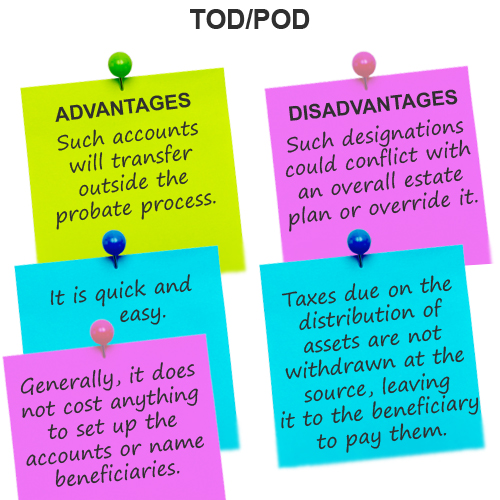
Transfer on Death (TOD) or Payable on Death (POD) Not Matching Wills
A simple and easy way to help avoid probate is to name someone as a transfer on death (TOD) beneficiary or a payable on death (POD) beneficiary. The terms are essentially the same but apply to slightly different accounts. A TOD/POD beneficiary can be named on financial accounts, such as bank savings or checking accounts and investment accounts, vehicle titles, and—in some states—real property.
Despite their simplicity, one major issue with TOD-/POD-titled assets is a lack of awareness or poor coordination with overall estate planning strategies. Some people might not realize that a TOD- or POD-titled asset overrides whatever is stated in a will. If a number of accounts are titled as TOD or POD, a will can be rendered largely ineffective, and assets may not be distributed as intended because the TOD/POD beneficiary designations don’t align with those established in the will.
Estate taxes may be due on TOD assets depending on, among other things, how the will is drafted. If there are tax issues, relying on TOD/POD beneficiary designations may not be enough, and a more complex estate plan may be needed.
https://www.fidelity.com/viewpoints/estate-planning-to-dos
https://www.fidelity.com/viewpoints/estate-planning-to-dos
Wednesday, April 19, 2017

Friday, March 31, 2017
Estate Planning for the Digital Era
Estate Planning for the Digital Era
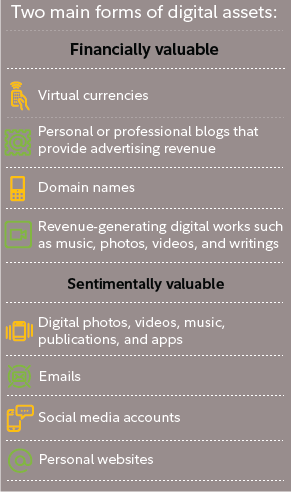
Digital Estate Planning To-Dos:
✔ Make a list of your digital assets and passwords so others know where to find them.
✔ Back up data stored in the cloud to a local computer or storage device.
✔ Work with an attorney to provide consent in legal documents.
https://www.fidelity.com/viewpoints/wealth-management/estate-planning-for-digital-assets?ccsource=email_weekly
Wednesday, October 26, 2016
Friday, September 9, 2016
Wednesday, December 30, 2015
Top 10 Viewpoints of 2015

Which topics were the most useful? A quick glance at the list reveals an interest in estate planning, retirement income, Social Security, and how to navigate market volatility.
If you missed any of these popular pieces, now’s a great time to use them to help recharge your finances—and spirits—for the new year. Happy reading and our best wishes for a very prosperous 2016!
| 1. | Estate plan pitfalls to avoid |
Do you know who your beneficiaries are, and how your assets are titled? These may seem like simple questions, but if you've spent many years accumulating bank and brokerage accounts, real estate, retirement accounts, annuities, and other assets, it’s not uncommon to forget or fail to update this important information. Find out why choosing the right accounts and forms of ownership is key—and how to get them right—in “Estate plan pitfalls to avoid.”
| 2. | Why establish an estate plan? |
Having a plan for what happens with your savings, investments, real estate, and other assets after your death may not be something you want to think about. But estate planning is very important—after all, you have worked hard for what you have. Do you really want someone else to make decisions about the transfer of your assets? To find out why almost everyone may benefit from an estate plan, regardless of how much money they have, read “Why establish an estate plan?”
| 3. | Five ways to protect your retirement income |
If you’re nearing or in retirement, it’s important to think about protecting what you've saved and ensuring that your income needs are met now and in the future. We’ve outlined five rules of thumb to help manage the risks to your retirement income. Read “Five ways to protect your retirement income.”
| 4. | How to spend from a 529 account |
Year after year, you have been saving diligently for college through a 529 college savings account. Now college is closer and it’s time to think about spending the money you’ve put aside. You’ll be in control of how much is withdrawn and how it’ll be used, but there are a few things you need to know up front to make the most of your savings. Learn about a nine-step guide to help you make your 529 college savings go as far as possible in “How to spend from a 529 college plan.”
| 5. | New Social Security rules |
The October budget agreement did more than authorize the federal government to engage in additional borrowing; it also changed the rules for claiming Social Security. Going forward, two claiming strategies that had given some couples the potential for higher lifetime benefits will no longer be available. Find out the details and how you may be affected in “New Social Security rules.”
| 6. | Pros' guide to diversification |
Stock market swings in 2015 might have changed your mix of stocks and bonds. You may need to bring your portfolio back in line with a diversified mix that is appropriate for your situation. For help analyzing your overall portfolio, choosing a target investment mix, and rebalancing your portfolio to bring it in line with that mix, read “The pros’ guide to diversification” and visit our Planning & Guidance Center (log in required).
| 7. | Six strategies for volatile markets |
Market volatility in late August and early September had investors concerned. Rather than focusing on the turbulence, wondering if you need to do something now, or what the market will do tomorrow, it makes more sense to focus on developing and maintaining a sound, long-term investing plan. Read our “Six strategies for volatile markets.”
| 8. | If you are a non-spouse IRA beneficiary |
Retirement accounts pass directly to named beneficiaries, rather than becoming part of your estate. This can provide significant tax advantages for your heirs. If you are the son, daughter, brother, sister, or even a close friend of an IRA owner who has named you as his or her beneficiary, it's critical that you—and the owner of the IRA—understand the rules that govern IRA inheritances. If you are married, keep in mind that most employer-sponsored retirement plans automatically designate your spouse as the beneficiary unless your spouse has consented in writing to allow another primary beneficiary. For more details, read “If you are a non-spouse IRA beneficiary.”
| 9. | Looking for income |
With 2015’s low interest rates and an uncertain outlook, many investors who were looking to generate current income—and could tolerate the extra risk—started considering non-bond income-generating investments. Among them: high-dividend-yielding stocks, preferreds, convertibles, and REITs. Find out more about a beyond-bonds income strategy in “Looking for income.”
| 10. | Putting the pullback into perspective |
The sell-offs in the markets in late August were sharp—a 1,000 point intraday decline in the Dow Jones Industrial Average during trading on August 24 was the largest intraday point drop ever. Investors were anxious. A panel of Fidelity experts gathered for a webcast to discuss the latest market events. Watch the full replay of the webcast and get the key takeaways for investors in “Putting the pullback into perspective.”
https://www.fidelity.com/viewpoints/personal-finance/top-viewpoints-articles-2015?ccsource=email_weekly
Friday, May 1, 2015
Wednesday, April 29, 2015
Estate Planning: The Pros & Cons of Transfer On Death (TOD) and Payable On Death (POD) Authorizations
Pitfall to Avoid: Transfer on Death or Payable on Death not Matching Wills
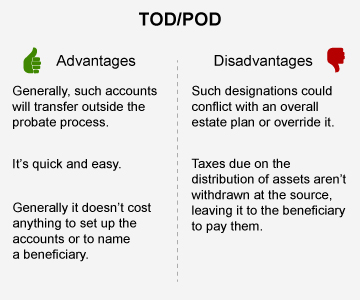
A simple and easy way to help avoid probate is to name someone as a transfer on death (TOD) beneficiary or a payable on death (POD) beneficiary.
The terms are essentially the same but apply to slightly different accounts. A TOD/POD beneficiary can be named on financial accounts, such as bank savings or checking accounts and investment accounts, vehicle titles, and––in some states––real property.
The terms are essentially the same but apply to slightly different accounts. A TOD/POD beneficiary can be named on financial accounts, such as bank savings or checking accounts and investment accounts, vehicle titles, and––in some states––real property.
Despite their simplicity, one major issue with TOD/POD-titled assets is a lack of awareness or poor coordination with people’s overall estate planning strategies.
If a number of accounts are titled as TOD, a will can be rendered largely ineffective, and assets may not be distributed as intended.
“You could have a complex will with all sorts of trusts created for your children,” says Pamela Pirone-Benson, a Fidelity estate planning specialist. “But if the assets don’t pass by the terms of the will, then the will becomes an expensive paperweight.”
Lubar describes transfer on death as a “placeholder,” rather than an estate plan. “It’s a temporary bandage until you put a larger, more effective, comprehensive plan in place.”
Consider Susan, a hypothetical client with a brokerage account worth $1 million.
She names her husband as a TOD beneficiary of the $1 million account. Five years later, she does some estate planning and states in her will that the account’s assets be split evenly between her two daughters from a different marriage.
Unfortunately, Susan doesn’t realize that her now ex-husband will receive the assets, because the TOD registration overrides the will.
Another problem with a TOD or POD could occur if parents name their children individually as TOD on each of two separate accounts. At the time the assets are titled, the value of the two accounts is equal. But no one tracks the value of the accounts over time.
Thirty years later, when the couple dies, one child could receive a much smaller sum than the other.
She names her husband as a TOD beneficiary of the $1 million account. Five years later, she does some estate planning and states in her will that the account’s assets be split evenly between her two daughters from a different marriage.
Unfortunately, Susan doesn’t realize that her now ex-husband will receive the assets, because the TOD registration overrides the will.
Another problem with a TOD or POD could occur if parents name their children individually as TOD on each of two separate accounts. At the time the assets are titled, the value of the two accounts is equal. But no one tracks the value of the accounts over time.
Thirty years later, when the couple dies, one child could receive a much smaller sum than the other.
And estate taxes may be due on TOD assets and payable by the recipient, depending on, among other things, how the will is drafted.
“This can create an administrative nightmare for the executor of the will, who then needs to go and collect taxes from the recipients after they receive the assets,” says Pirone-Benson.
“This can create an administrative nightmare for the executor of the will, who then needs to go and collect taxes from the recipients after they receive the assets,” says Pirone-Benson.
Wednesday, April 22, 2015
Friday, December 7, 2012
10 Estate Planning Tasks To Complete Before 2013: #1. Get Your Plan Finalized

#1. Have Your Estate Planning Finalized.
You should set the end of the year as a deadline to finally get this completed. Figure out why you have been procrastinating and conquer your fears.
If it’s because you don’t have an attorney, ask friends and acquaintances for referrals. If it’s because you aren’t sure who you want to be the guardian for your minor children or who you want to be your executor or trustee or how to divide your estate, your attorney and advisor can help you decide.
(You can always change your mind later; don’t let these decisions keep you from putting a plan in place now.)
If money is an issue, start with what you can afford (a will, power of attorney, health care documents) and upgrade later when you can. Your attorney may also be willing to accept payments.
Thursday, December 6, 2012
10 Estate Planning Tasks To Complete Before 2013: #2. Review & Update Your Plan
#2. Review and update your existing estate plan.
 Personal and financial circumstances will change throughout your lifetime, and your plan needs to change with them.
Revisions should be made any time there are changes in your family (birth, death, marriage, divorce, remarriage), your finances, tax laws, or if a trustee or executor can no longer serve.
Now is a perfect time to do this; if there are changes you want to share with family members, you can do that when they are home for the holidays.
Wednesday, December 5, 2012
10 Estate Planning Tasks To Complete Before 2013: #3. Use Your $5.12 Million Exemption
#3. Use Your $5.12 Million Exemption.
 For the rest of this year, every American can transfer up to $5.12 million free of federal gift, estate and generation-skipping transfer tax.
 (A married couple can transfer up to $10.24 million.)
If Congress does not change the current law, the federal estate tax exemption in 2013 will be just $1 million.
You do not have to die in 2012 to use this exemption; you can use it to make gifts now, while you are living. You do not have to completely give away your assets; you can make the transfers in ways that will let you keep control and even keep the income your assets are generating. And you do not have to use the full $5.12 million exemption to benefit.
Even those with less than $1 million should consider some planning to prevent future tax liability.
Tuesday, December 4, 2012
10 Estate Planning Tasks To Complete Before 2013: #4. Make Tax-Free Gifts.
 #4. Make Tax-Free Gifts.
Under current federal law, you can give up to $13,000 to as any people as you wish each year. This is a great way to reduce the size of your estate (and potentially save estate taxes) over time.
For example, if you give $13,000 per year to your two children and three grandchildren, you would remove $65,000 from your estate in just one year and $325,000 in five years.
(You can double these amounts if you are married.)
Charitable gifts are unlimited. So are gifts for tuition and medical expenses, if you give directly to the institution.
Friday, November 30, 2012
10 Estate Planning Tasks To Complete Before 2013: #5. Secure/Update Health Care Documents.
#5. Secure/Update Health Care Documents.

At the minimum, everyone over the age of 18 needs...
1) a durable power of attorney for health care, which gives another person legal authority to make health care decisions (including life and death decisions) for you if you are unable to make them for yourself; and
2) HIPPA authorizations, which give written consent for doctors to discuss your medical situation with others, including family members.
In addition, a revocable living trust is preferable over a will at incapacity because it can prevent the court from controlling your assets.
Thursday, November 29, 2012
10 Estate Planning Tasks To Complete Before 2013: #6. Review/Update Guardian for Minor Kids.
 #6. Review/Update Guardian for Minor Kids.
It is quite likely that the person you name as guardian for your children when they are small will not be the best choice as they get older. Also, this person could change his/her mind, move away or even become ill or die.
Revisit your choice from time to time, and name more than one in case your first choice cannot serve.
Remember, if you haven’t named a guardian who is able and willing to serve and something happens to you, the court will decide who will raise your kids.
Wednesday, November 28, 2012
10 Estate Planning Tasks To Complete Before 2013: #7. Review/Update Beneficiary Designations
 #7. Review/Update Beneficiary Designations.
 This is especially important if your beneficiary has died or if you are divorced.
If your beneficiary is incapacitated or is a minor, setting up a trust for this person and naming the trust as beneficiary will prevent the court from taking control of the proceeds.
Tuesday, November 27, 2012
10 Estate Planning Tasks To Complete Before 2013: #8. Review/Update Your Life Insurance
#8. Review/Update Your Life Insurance. Check the amount of your life insurance coverage and see if it meets your family’s current needs.
Consider getting Long-Term Care Insurance to help pay for the costs of long-term care (and preserve your assets for your family) in the event you and/or your spouse should need it due to illness or injury.
Subscribe to:
Posts (Atom)