Showing posts with label rate hike. Show all posts

Friday, December 23, 2016

The 1st Fed Rate Hike: 5 Charts Show the 1st Fed Rate Increase Has NOT Been A Showstopper for Investors


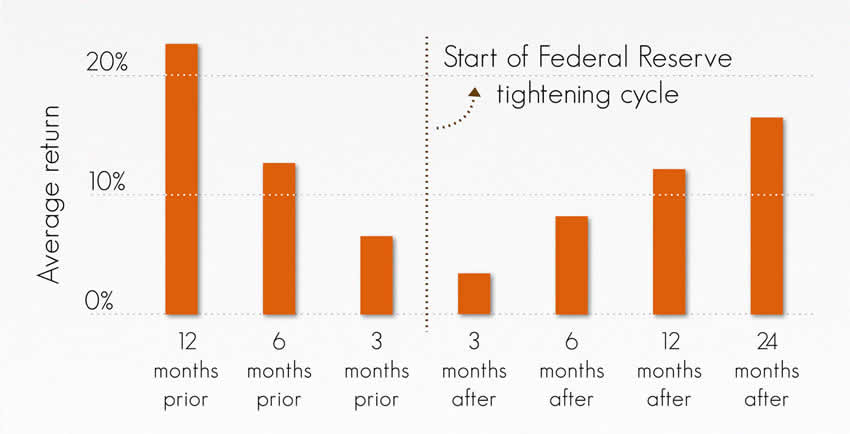
Stocks have posted gains before and after the first rate hike.
In 2016, for the first time in nearly 9 years, the Fed raised its short-term borrowing rate.

History may hold valuable clues for investors who are looking to understand what a rate hike may mean for them.
The bottom line is that while a rate hike may mark a turning point in policy and create volatility, it hasn’t historically been an inflection point for investment performance. Instead, the first rate hike has most often come during the mid-phase of the business cycle, a period when most investments have produced positive performance. 
Here are some key lessons from the past, based on analysis from Fidelity’s Asset Allocation Research Team (AART). For all the charts that follow, it is worth noting that these results are averages, and in each instance of rate hikes, markets behave differently.


1. Stock gains continue after initial rate move.

While rate hikes may cause volatility, the first rate hike usually takes place during the mid-phase of the business cycle, when profits are strong and the economy is growing. Despite the rate hike, stocks have averaged double-digit gains in the year before and after the first Fed move.
Stocks have posted gains before and after the first rate hike.

Read the remainder of the report here...

Wednesday, January 6, 2016

Fed Raises Rates: What’s Next?


In mid-December, the Federal Reserve announced the first rate hike in nearly 10 years. Here are four things to keep in mind.

1. The first rate hike usually indicates economic improvement, not an imminent market downturn.

It’s important to keep in mind the context of today’s action. Historically, the first Fed hikes have not precipitated economic or market downturns. Typically, the first rate increase has been a signal that the economy has gained traction, and on average, asset markets have typically performed relatively well in the year or two after the first hike.

2. This round of rate hikes may be gradual.

This round of rates hikes is starting as the Fed faces a far weaker backdrop for global growth—as well as much lower inflation—than is typical for the first rate hike in a cycle. This would seem to imply the Fed will move forward at a gradual pace of tightening. This weaker global and inflation environment makes a dramatic spike in interest rates less likely.

3. Higher rates could pressure commodities and emerging markets.

It is important to keep in mind that Fed monetary tightening does tighten global dollar liquidity as well. Because the dollar is the world’s reserve currency, this tighter liquidity has made it more difficult for many asset prices in recent months—including emerging-market equities, non-U.S. currencies, and commodity prices. These markets may remain volatile in the aftermath of the Fed’s first hike.

4. The economy could stabilize.

Finally, our outlook is that the global economy will digest the Fed hike over the coming months. The rate increase may even boost confidence in the U.S. economy by reassuring us all that we are finally on a path to normalization. And with the U.S. still in a steady mid-cycle expansion, we expect the global economy to stabilize over the course of 2016. Markets are likely to be choppy, but overall I think the outlook for equities should be relatively favorable as the year unfolds.

https://www.fidelity.com/viewpoints/market-and-economic-insights/fed-raises-rate?ccsource=email_weekly


© 2015 These presentations are provided for informational purposes only. Read relevant legal disclosures.

Wednesday, May 13, 2015

Wage Growth Metric is Precisely Where It Was the Last Time the Fed Started Hiking Rates...

This Wage Growth Metric is Exactly Where It Was the Last Time the Fed Started Hiking Rates 

Wage growth is here.

On Thursday, we got the latest Employment Cost Index (or ECI), which climbed +0.7% in the first quarter, beating the estimate for a +0.6% gain. The index climbed +2.2% quarter-over-quarter, and +2.6% over the previous year.

That led one economist to suggest that the economy is "beyond full employment." 

And Steven Englander, Citi's global head of fixed income strategy, highlights something else that's remarkable about the ECI.

"ECI wages and salaries (dark blue) are now exactly where they were when fed funds began to rise in 2004," Englander said. He highlighted this with a chart.

Englander notes that while wages were falling then, they are rising now. 

The sluggish pace of wage growth is one of the biggest things that has kept the Fed on hold. On Thursday, the ECI, as well as the lower-than-expected initial jobless claims print for last week, signalled more tightness in the labor market.

To be clear, Citi's economists are not calling for the Federal Reserve to begin hiking rates in June. Englander only points to it as an "interesting" observation.

However, Cleveland Fed president Loretta Mester, said a rate hike next month is still "on the table," according to Reuters.


Wednesday, October 1, 2014

Historically, What Do Stocks Do Before And After The Fed Starts Hiking Rates?...

cotd sp500 rate hikes

Sooner or later, the Federal Reserve will begin normalizing monetary policy, which means higher interest rates are coming.

This has investors rightfully worried because higher rates mean higher interest costs, which should be bad for profits and ultimately stocks.

Deutsche Bank Chief US Equity Strategist David Bianco examined the history of Fed rate hikes and their impacts on stocks.

"Stocks typically sell-off on the first of a series of rate hikes, but the magnitude and duration of the sell-off depend on conditions," Bianco writes. "During early cycle hikes the initial sell-off was generally small, quickly recovered and further S&P gains came in next three months and longer (like 2004, 1983, 1972). But many sell- offs on late cycle hikes became corrections or even bear markets."

Unfortunately, it's only in hindsight do we know where we are in the cycle.

"Determining whether it’s early or late in the cycle is subjective, but the shape of the curve, inflation measures, years since the last recession can help," Bianco said. "Next year is likely another mid-cycle year and we don’t expect a severe S&P reaction to hikes, but the risk is the Fed hikes too late or too little and inflation accelerates requiring the Fed to hike to levels higher than expected."

Bianco's 27-page research note is riddled with exhibits. But we thought this one was pretty elegant.

It's the average price move of the S&P 500 during the 4 months before and the 6 months after the 1st rate hike. It's the average of the last 7 hikes.

It's not the most helpful chart for people who enjoy obsessing over the details. It does, however, show that the general direction of the stock market tends to be up.


Read more: http://www.businessinsider.com/how-stocks-move-around-first-fed-rate-hikes-2014-9#ixzz3EMoczX9P