Showing posts with label LTC. Show all posts
Showing posts with label LTC. Show all posts
Wednesday, May 10, 2017


Friday, May 5, 2017
Wednesday, August 10, 2016
Wednesday, July 27, 2016
Friday, April 22, 2016

Friday, April 15, 2016

Friday, April 8, 2016

Friday, March 25, 2016

Wednesday, March 16, 2016

Wednesday, March 2, 2016

Friday, November 21, 2014
Medicare: 7 Things You Don't Know - #1. Not Everything Is Covered
 Couples retiring at age 65 this year are expected to incur $220,000 in out-of-pocket health care costs on average during their retirement years, INCLUDING deductibles, co-payments and services NOT covered by Medicare such as dental, vision and podiatry expenses.
 The estimate DOES NOT include Long-Term Care (LTC) costs.
Source: Fidelity Investments’ 2014 Retirement Health Care Cost Estimate.
Wednesday, September 24, 2014

Friday, August 1, 2014
The Top 10 Retirement Challenges: #10. Long-Term Care Protection

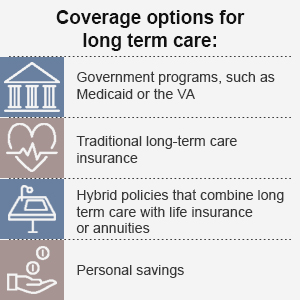
Looking broadly at how to fund these costs is important, whether that means self-insuring if you have enough assets or buying some form of Long-Term Care insurance (LTCi).
Wednesday, June 25, 2014

Wednesday, February 22, 2012

Thursday, October 27, 2011
Amid Retirement Worries, Owners Of Annuities And Long-Term Care Insurance Are Most Confident
Confidence among U.S. workers in their retirement prospects plummeted -18.2% this year to a four-year low.
One in five working Americans now say they do not plan to retire at all, according to a survey by Sun Life Financial.
All five subject areas covered by the poll fell this year, including employee benefits (-31.7%), the economy (-25.0%), government benefits (-21.6%), personal finances (-13.9%), and personal health (-13.2%).
Only 23% of working Americans feel very confident that they will meet basic living expenses in retirement, a huge drop from 42% last year.
Confidence in the future of Social Security fell to just 9%, continuing a steady plunge from 22% in 2008. Confidence about receiving adequate Medicare benefits has fallen to 8% from 20% in 2008.
The respondents who felt most confident about their retirement are those who expect to receive guaranteed lifetime income from annuities by age 67, or who own long-term care insurance products.
Wes Thompson, president of Sun Life Financial U.S., said in a written statement, “We believe the higher confidence of respondents across all wealth levels who own either variable annuities or long-term care insurance vehicles provides a positive wake-up call: Americans can take action to help secure their future and feel more secure about their golden years.”
One in five working Americans now say they do not plan to retire at all, according to a survey by Sun Life Financial.
Retirement confidence levels had remained level for the past three years as measured by Sun Life’s Unretirement Index, a survey of nearly 1,500 workers. On a scale of 1 to 100, the index fell from 44 in September 2010 to 36 in September 2011.
All five subject areas covered by the poll fell this year, including employee benefits (-31.7%), the economy (-25.0%), government benefits (-21.6%), personal finances (-13.9%), and personal health (-13.2%).
Only 23% of working Americans feel very confident that they will meet basic living expenses in retirement, a huge drop from 42% last year.
Confidence in the future of Social Security fell to just 9%, continuing a steady plunge from 22% in 2008. Confidence about receiving adequate Medicare benefits has fallen to 8% from 20% in 2008.
The respondents who felt most confident about their retirement are those who expect to receive guaranteed lifetime income from annuities by age 67, or who own long-term care insurance products.
Wes Thompson, president of Sun Life Financial U.S., said in a written statement, “We believe the higher confidence of respondents across all wealth levels who own either variable annuities or long-term care insurance vehicles provides a positive wake-up call: Americans can take action to help secure their future and feel more secure about their golden years.”
Friday, October 7, 2011
Long-Term Care: 70% of Americans Over Age 65 Will Need It...

Some 70% of Americans older than age 65 will need long-term care, meaning help with daily activities such as eating and bathing, according to the U.S. Department of Health and Human Services.
Yet the same survey found that almost no one had discussed long-term care insurance with a financial adviser or lawyer.
Friday, July 15, 2011
Baby Boomers Giving Care To Parents Soars...
- $3 trillion — Amount Americans caregiving for their parents stand to miss out in wages, pension income and Social Security benefits.
- $324,044 — Amount women lose on average caring for their parents.
- $283,716 — Amount men lose on average caring for their parents.
Americans caregiving for their parents stand to miss out on an estimated total of $3 trillion in wages, pension income and Social Security benefits when they take time off or leave the workforce due to their caregiving responsibilities, according to a study.
The Metlife study, "Double Jeopardy for Baby Boomers Caring for Their Parents," reports that individually, average losses are $324,044 for women and $283,716 for men.
The number of adults providing care to a parent has tripled since 1994.
"Nearly 10 million adult children over the age of 50 care for their aging parents," said Sandra Timmermann, Ed.D., director of the MetLife Mature Market Institute.
“Assessing the long-term financial impact of caregiving for aging parents on caregivers themselves, especially those who must curtail their working careers to do so, is especially important, since it can jeopardize their future financial security."
The study also found that:
- Americans 50 years or older who work and provide care to a parent are more likely to report that their health is fair or poor than those who do not provide care.
- Due to leaving the workforce early, women lose $142,693 in wages, $131,351 in Social Security benefits and approximately $50,000 in pension income.
- Men lose $89,107 in wages when they leave the workforce early, $144,609 in Social Security benefits and $50,000 in pension income.
"There is also evidence that caregivers experience considerable health issues as a result of their focus on caring for others. The need for flexibility in the workplace and in policies that would benefit working caregivers is likely to increase in importance as more working caregivers approach their own retirement, while still caring for their loved ones."
Source: Metlife Mature Institute
The MetLife Mature Market Institute is MetLife's center of expertise in aging, longevity and the generations and is a recognized thought leader by business, the media, opinion leaders and the public. The Institute's groundbreaking research, insights, strategic partnerships and consumer education expand the knowledge and choices for those in, approaching or working with the mature market. - Americans 50 years or older who work and provide care to a parent are more likely to report that their health is fair or poor than those who do not provide care.
Friday, June 24, 2011
8 Long-Term Care Facts & Fallacies You Need To Know...
- 70% — Percentage of people over the age of 65 who will end up needing long-term care at some point in their lives.
- 54% — Percentage of baby boomers who believe that Medicare covers long-term care. IT DOESN'T!
- 3 Years — Average time frame women over the age of 65 require long-term care, twice as long as men.
- 75% — Percentage of nursing home patients who are women.
- 2x — The rate at which long-term care costs are rising faster than inflation.
- $247 — The average daily cost of daily care in a nursing home with a private room.
- $90,155 — The average annual cost of daily care in a nursing home with a private room.
- $270,465 — The average total cost for 3 years of daily care in a nursing home with a private room.
Wednesday, June 15, 2011
Long-Term Care Buyer's Prefer Limited-Duration Policies...
- 57.1% — Percentage of LTCI buyers who selected policies with a benefit period of 4 years or less.
- 80.7% — Percentage of LTCI buyers who were under the age of 65.
- 56.0% — Percentage of LTCI buyers who were between the ages of 55-64.
"Limited duration policies continue to become the preferred choice of many consumers who benefit from their lower cost and are willing to assume some of the risk for a catastrophic long-term care event," states Jesse Slome, AALTCI's executive director.
"Given the economic uncertainty of the past few years, it is understandable that consumers favor ways to reduce the cost of coverage that, while important, is still a discretionary purchase," Slome notes.
"In addition, newer product design features such as the "shared care" option allow couples to purchase more affordable limited-duration policies and still be protected if one spouse requires care for longer than provided by their own policy."
According to the AALTCI, more than 75% of individual long-term care insurance policies are purchased by couples.
Subscribe to:
Posts (Atom)