Showing posts with label Social Security. Show all posts
Showing posts with label Social Security. Show all posts
Friday, May 26, 2017


Wednesday, May 24, 2017

Friday, May 19, 2017


Wednesday, May 17, 2017
Social Security: Breakeven Periods

In essence, as long as the divorcee believes he/she can survive to breakeven age, it’s beneficial to delay an ex-spouse’s spousal benefit. To the extent that the divorcee lives materially longer, inflation is higher and/or market returns are lower, the decision to delay will look even better.
Social Security Claiming Strategies for Divorcees | Financial Planning
Wednesday, March 29, 2017
5 Common Annuity Myths
5 Common Annuity Myths
Myth 1: Annuities are Only for Retirees.
| Reality: | Annuities can help savers, too. |
Myth 2: Annuities Cost Too Much.
| Reality: | Many annuities are low cost. Others offer potentially valuable additional features at higher costs, which you should consider only if you need to address a specific risk. |
Myth 3: There is No Point in Buying an Annuity for Income before Retirement.
| Reality: | As you approach retirement, certain annuities can help protect your future income from market volatility, and some annuities can help protect against inflation. |
Myth 4: I can easily Create Lifetime Income from my Retirement Accounts.
| Reality: | Besides Social Security and pensions, only annuities guarantee a stream of income that you can’t outlive. |
Myth 5: The Insurance Company gets My Money When I Die.
| Reality: | Your beneficiaries can receive payment(s) after you die. |
Friday, February 24, 2017
CBO: Social Security Trust Fund Gone In 2029

The problem is that entitlement spending will grow faster than the economy and tax revenue, fueled by an aging population, rising health care costs and expanding ObamaCare enrollment.
Read More At Investor's Business Daily:
http://news.investors.com/politics/061615-757616-social-security-trust-fund-ends-in-2029-autopilot-spending.htm#ixzz3dLzNQCpA
Friday, February 10, 2017
Case Study: Managing Taxation on Retirement Income Withdrawals
Example: How to Manage Taxes on Withdrawals for Retirement Accounts.
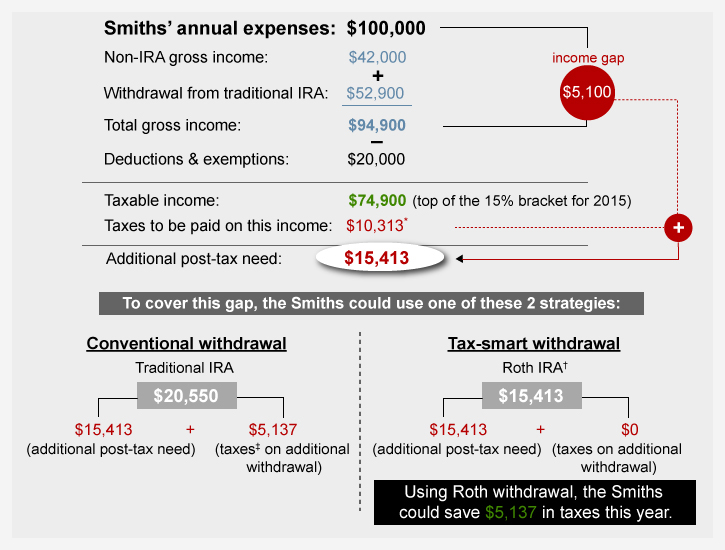
This hypothetical example is for illustrative purposes only. This hypothetical scenario assumed the couple does not receive Social Security benefits. Social Security income would further complicate the tax scenario described above and should be considered when creating a withdrawal strategy.
As a way to help minimize the taxes you’ll pay, consider the following hypothetical scenario. It illustrates the way a retired married couple whose annual expenses total $100,000 might seek to manage their taxes.
Our hypothetical couple expects $42,000 in gross income (all taxable) before tapping their retirement accounts, so their gross income gap—(before considering taxes)—is $58,000. They anticipate $20,000 in deductions and exemptions, so their expected taxable income before withdrawals is $22,000. If they withdraw $52,900 from their traditional IRAs, it would bring their taxable income to $74,900—the top of the 15% bracket. They could then withdraw the remaining $5,100 that they need to cover their income gap from a Roth IRA, which does not generate taxable income (assuming the withdrawal is qualified). The chart (above) shows their cash flow and taxable income.
Our hypothetical couple expects $42,000 in gross income (all taxable) before tapping their retirement accounts, so their gross income gap—(before considering taxes)—is $58,000. They anticipate $20,000 in deductions and exemptions, so their expected taxable income before withdrawals is $22,000. If they withdraw $52,900 from their traditional IRAs, it would bring their taxable income to $74,900—the top of the 15% bracket. They could then withdraw the remaining $5,100 that they need to cover their income gap from a Roth IRA, which does not generate taxable income (assuming the withdrawal is qualified). The chart (above) shows their cash flow and taxable income.
Other Options for Our Hypothetical Couple
The hypothetical couple in this scenario leaves the bulk of Roth IRA assets alone, leaving them in place to potentially generate tax-free growth. In certain situations, however, it may be advantageous to tap Roth assets instead of tax-deferred or taxable accounts. These include situations when:
- Any distributions at all from a tax-deferred account would cause your taxable income to exceed your target marginal tax rate
- Withdrawing from a taxable account would require selling assets held less than a year, resulting in short-term capital gains, which are taxed at ordinary income tax rates
- You are also trying to minimize taxes on Social Security benefits, withdrawals from a tax-deferred account would have an impact on the taxability of those benefits
Your circumstances may be considerably different from those described in the scenario. Nevertheless, you may be able to apply the principles to your own situation. A tax professional can help you explore the implications of different withdrawal strategies, help minimize the amount of taxes you pay on hard-earned savings, and, of course, help you maximize your ability to live the retirement you envision.
Friday, January 13, 2017
Social Security: Strategy #1: Maximize Lifetime Benefits
| Strategy No. 1: | Maximize Lifetime Benefits. |
A couple with similar incomes and ages may maximize lifetime benefits if both delay.

How it works: The basic principle is that the longer you defer your benefits, the larger they grow. Each year you delay Social Security from age 62 to 70 could increase your benefit by up to +8.0%.
Whom it may benefit: This strategy works best for couples with normal to high life expectancies with similar earnings, who are planning to work until age 70 or have sufficient savings to provide any needed income during the deferral period.
Example: Willard’s life expectancy is 88, and his income is $75,000. Helena’s life expectancy is 90, and her income is $70,000. They enjoy working. Suppose Willard and Helena both claim at age 62. As a couple, they would receive a lifetime benefit of $1,230,000. But if they live to be ages 88 and 90, respectively, deferring to age 70 would mean about $120,000 in additional benefits.
Learn More...
Read Viewpoints: “How the get the most from Social Security."- Watch Learning Center Video: Social Security: 5 key considerations to know before claiming your benefit.
- Visit the SSA website
 to request your Social Security statement, calculate your FRA, or estimate your future retirement, disability, or survivor benefits. You can also get additional information in the FAQ section.
 - Enter your estimated Social Security benefit information into the Fidelity Planning & Guidance Center to see how Social Security fits with your overall retirement plan.
Wednesday, November 30, 2016
Wednesday, September 21, 2016
Wednesday, July 13, 2016

Friday, June 10, 2016
Wednesday, April 20, 2016
Maximizing Social Security for Couples
A Couple with Similar Incomes and Ages may Maximize Lifetime Benefits if Both Delay.
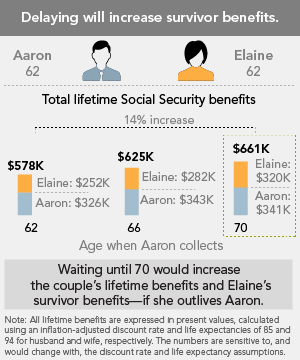
A Couple with Shorter Life Expectancies May Want to Claim Earlier...
Read more here...
Social Security Tips for Couples - Fidelity Investments
Friday, February 26, 2016

Wednesday, December 30, 2015
Top 10 Viewpoints of 2015

Which topics were the most useful? A quick glance at the list reveals an interest in estate planning, retirement income, Social Security, and how to navigate market volatility.
If you missed any of these popular pieces, now’s a great time to use them to help recharge your finances—and spirits—for the new year. Happy reading and our best wishes for a very prosperous 2016!
| 1. | Estate plan pitfalls to avoid |
Do you know who your beneficiaries are, and how your assets are titled? These may seem like simple questions, but if you've spent many years accumulating bank and brokerage accounts, real estate, retirement accounts, annuities, and other assets, it’s not uncommon to forget or fail to update this important information. Find out why choosing the right accounts and forms of ownership is key—and how to get them right—in “Estate plan pitfalls to avoid.”
| 2. | Why establish an estate plan? |
Having a plan for what happens with your savings, investments, real estate, and other assets after your death may not be something you want to think about. But estate planning is very important—after all, you have worked hard for what you have. Do you really want someone else to make decisions about the transfer of your assets? To find out why almost everyone may benefit from an estate plan, regardless of how much money they have, read “Why establish an estate plan?”
| 3. | Five ways to protect your retirement income |
If you’re nearing or in retirement, it’s important to think about protecting what you've saved and ensuring that your income needs are met now and in the future. We’ve outlined five rules of thumb to help manage the risks to your retirement income. Read “Five ways to protect your retirement income.”
| 4. | How to spend from a 529 account |
Year after year, you have been saving diligently for college through a 529 college savings account. Now college is closer and it’s time to think about spending the money you’ve put aside. You’ll be in control of how much is withdrawn and how it’ll be used, but there are a few things you need to know up front to make the most of your savings. Learn about a nine-step guide to help you make your 529 college savings go as far as possible in “How to spend from a 529 college plan.”
| 5. | New Social Security rules |
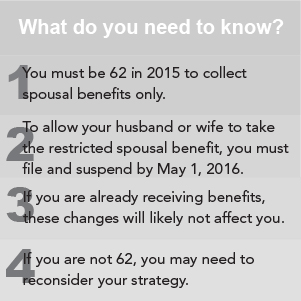
The October budget agreement did more than authorize the federal government to engage in additional borrowing; it also changed the rules for claiming Social Security. Going forward, two claiming strategies that had given some couples the potential for higher lifetime benefits will no longer be available. Find out the details and how you may be affected in “New Social Security rules.”
| 6. | Pros' guide to diversification |
Stock market swings in 2015 might have changed your mix of stocks and bonds. You may need to bring your portfolio back in line with a diversified mix that is appropriate for your situation. For help analyzing your overall portfolio, choosing a target investment mix, and rebalancing your portfolio to bring it in line with that mix, read “The pros’ guide to diversification” and visit our Planning & Guidance Center (log in required).
| 7. | Six strategies for volatile markets |
Market volatility in late August and early September had investors concerned. Rather than focusing on the turbulence, wondering if you need to do something now, or what the market will do tomorrow, it makes more sense to focus on developing and maintaining a sound, long-term investing plan. Read our “Six strategies for volatile markets.”
| 8. | If you are a non-spouse IRA beneficiary |
Retirement accounts pass directly to named beneficiaries, rather than becoming part of your estate. This can provide significant tax advantages for your heirs. If you are the son, daughter, brother, sister, or even a close friend of an IRA owner who has named you as his or her beneficiary, it's critical that you—and the owner of the IRA—understand the rules that govern IRA inheritances. If you are married, keep in mind that most employer-sponsored retirement plans automatically designate your spouse as the beneficiary unless your spouse has consented in writing to allow another primary beneficiary. For more details, read “If you are a non-spouse IRA beneficiary.”
| 9. | Looking for income |
With 2015’s low interest rates and an uncertain outlook, many investors who were looking to generate current income—and could tolerate the extra risk—started considering non-bond income-generating investments. Among them: high-dividend-yielding stocks, preferreds, convertibles, and REITs. Find out more about a beyond-bonds income strategy in “Looking for income.”
| 10. | Putting the pullback into perspective |
The sell-offs in the markets in late August were sharp—a 1,000 point intraday decline in the Dow Jones Industrial Average during trading on August 24 was the largest intraday point drop ever. Investors were anxious. A panel of Fidelity experts gathered for a webcast to discuss the latest market events. Watch the full replay of the webcast and get the key takeaways for investors in “Putting the pullback into perspective.”
https://www.fidelity.com/viewpoints/personal-finance/top-viewpoints-articles-2015?ccsource=email_weekly
Wednesday, December 16, 2015

Wednesday, November 25, 2015
Wednesday, November 18, 2015
CBO: Social Security Trust Fund Gone In 2029

The Congressional Budget Office now projects that Social Security's $2.8 trillion trust fund will run dry in 2029 — less than a decade before the end of the next president's first term. At that point, an automatic benefit cut of 28% would take effect.
Read More At Investor's Business Daily:
Wednesday, November 11, 2015


Wednesday, June 24, 2015
Subscribe to:
Posts (Atom)