Friday, April 28, 2017

Can Life Insurance Help Your Estate Plan?


Ben Franklin said that in this world nothing is certain but death and taxes. Well, one product sits at the intersection of both—life insurance. It may not help you cheat death, but it may help manage taxes.

There are certain estate planning steps we should all take, including the creation of a will and a health care directive. But if you have enough wealth that you expect your estate to be taxed—at either the state or the federal level—you may want to consider more advanced strategies, including using life insurance in a trust.

Irrevocable Life Insurance Trust
 May provide cash for heirs to settle estate.
 Death benefit is generally not considered taxable income by the IRS.
 Choose an insurer with a strong rating.
 It is a complex legal arrangement requiring properly drafted documentation.
 Consult a legal advisor regarding your specific situation.
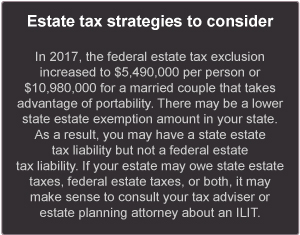
Estate tax strategies to consider

https://www.fidelity.com/viewpoints/personal-finance/can-life-insurance-help


Wednesday, April 26, 2017

Advantages and Disadvantages of Joint Ownership of Estates (with Definitions)


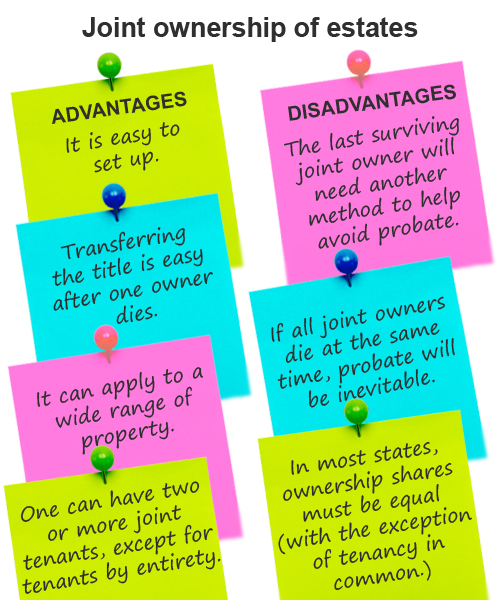
Joint ownership of estates

Joint ownership itself may be structured in different ways, which may affect an estate plan. Each type of joint ownership structure offers an undivided right to the use and enjoyment of the property. However, depending on the specific classification of joint ownership, the ultimate consequences of transfer at a joint owner’s death may vary.

There are three basic ways to title a joint account, and each of them has distinct implications for estate planning, depending on your situation.

Joint Tenancy with Rights of Survivorship: When one owner dies, property ownership transfers to the surviving owner(s) through the rights of survivorship. Probate may be avoided on the death of the first joint owner of a jointly held account but not necessarily on the death of the surviving joint owner. This is because the asset that was originally jointly held may now be titled solely in the name of the surviving joint owner, hence resulting in a potential probate on the death of the surviving joint owner unless measures are taken to avoid that result.

Tenancy by Entirety: This is similar to joint tenancy with rights of survivorship, except that it applies only to married couples, which would include married same-sex couples in some states.

Tenancy in Common: Unlike joint tenancy with rights of survivorship, with tenancy in common, when a joint owner dies, that owner’s interest in the property will become part of the deceased owner’s estate and will be passed on according to his or her will. A word of caution: Be careful establishing a tenancy in common account, because it will likely lead to probate issues.

https://www.fidelity.com/viewpoints/estate-planning-to-dos

Monday, April 24, 2017

Vantage Point UPDATE: Intermediate-Term and Long-Term Trend Analysis


On
Friday, April 21, the S&P 500 closed @ 2350, and that was...
  
   +4.3% ABOVE its 12-Month moving average which stood @ 2235.
   +4.2% ABOVE its 40-Week moving average which stood @ 2240.
   -1.1% BELOW its 10-Week moving average which stood @ 2359.


Therefore, the INTERMEDIATE-Term trend is NEUTRAL
and the LONG-Term trend is BULLISH.


Friday, April 21, 2017

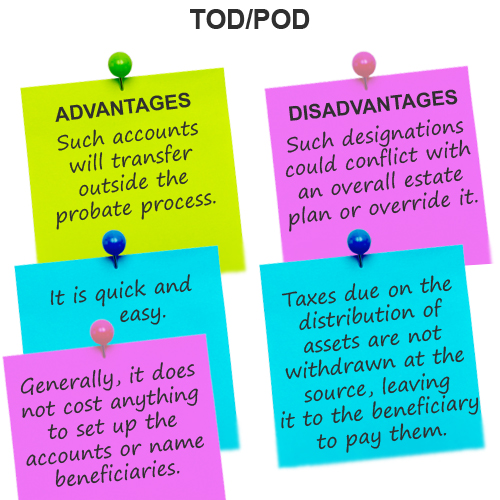
Estate Planning Pitfall to Avoid: Transfer on Death & Payable on Death


TOD vs. POD


Pitfall to Avoid: 

Transfer on Death (TOD) or Payable on Death (POD) Not Matching Wills


A simple and easy way to help avoid probate is to name someone as a transfer on death (TOD) beneficiary or a payable on death (POD) beneficiary. The terms are essentially the same but apply to slightly different accounts. A TOD/POD beneficiary can be named on financial accounts, such as bank savings or checking accounts and investment accounts, vehicle titles, and—in some states—real property.

Despite their simplicity, one major issue with TOD-/POD-titled assets is a lack of awareness or poor coordination with overall estate planning strategies. Some people might not realize that a TOD- or POD-titled asset overrides whatever is stated in a will. If a number of accounts are titled as TOD or POD, a will can be rendered largely ineffective, and assets may not be distributed as intended because the TOD/POD beneficiary designations don’t align with those established in the will.

Estate taxes may be due on TOD assets depending on, among other things, how the will is drafted. If there are tax issues, relying on TOD/POD beneficiary designations may not be enough, and a more complex estate plan may be needed.

https://www.fidelity.com/viewpoints/estate-planning-to-dos


Monday, April 17, 2017

Vantage Point UPDATE: Intermediate-Term and Long-Term Trend Analysis


On
Friday, April 14, the S&P 500 closed @ 2329, and that was...
  
   +4.3% ABOVE its 12-Month moving average which stood @ 2232.
   +4.2% ABOVE its 40-Week moving average which stood @ 2235.
   -1.1% BELOW its 10-Week moving average which stood @ 2356.


Therefore, the INTERMEDIATE-Term trend is NEUTRAL
and the LONG-Term trend is BULLISH.


Monday, April 10, 2017

Vantage Point UPDATE: Intermediate-Term and Long-Term Trend Analysis


On
Friday, April 7, the S&P 500 closed @ 2356, and that was...
  
   +5.3% ABOVE its 12-Month moving average which stood @ 2236.
   +5.6% ABOVE its 40-Week moving average which stood @ 2230.
   +0.1% ABOVE its 10-Week moving average which stood @ 2353.


Therefore, the INTERMEDIATE-Term trend is NEUTRAL
and the LONG-Term trend is BULLISH.


Wednesday, April 5, 2017

As U.S. Oil Production Soars, OPEC's Power and Influence Sinks...


“OPEC is the past, and its leverage over the economies of the world has been significantly diminished,” John Hickenlooper, a former oil-industry executive who is now Colorado governor, said recently. “We really control our own fates.”

Monday, April 3, 2017

Vantage Point UPDATE: Intermediate-Term and Long-Term Trend Analysis


On
Friday, March 31, the S&P 500 closed @ 2363, and that was...
  
   +6.7% ABOVE its 12-Month moving average which stood @ 2214.
   +6.2% ABOVE its 40-Week moving average which stood @ 2224.
   +0.7% ABOVE its 10-Week moving average which stood @ 2347.


Therefore, the INTERMEDIATE-Term trend is BULLISH
and the LONG-Term trend is BULLISH.


Friday, March 31, 2017

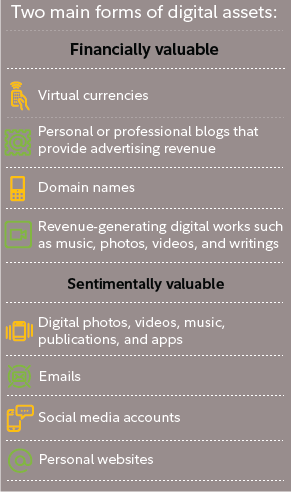
Estate Planning for the Digital Era


Estate Planning for the Digital Era

Digital Estate Planning To-Dos:


 Make a list of your digital assets and passwords so others know where to find them.

 Back up data stored in the cloud to a local computer or storage device.

 Work with an attorney to provide consent in legal documents.


Two main forms of digital assets:


https://www.fidelity.com/viewpoints/wealth-management/estate-planning-for-digital-assets?ccsource=email_weekly

Wednesday, March 29, 2017

5 Common Annuity Myths

5 Common Annuity Myths


Myth 1: Annuities are Only for Retirees.

Reality:Annuities can help savers, too.

Myth 2: Annuities Cost Too Much.

Reality:Many annuities are low cost. Others offer potentially valuable additional features at higher costs, which you should consider only if you need to address a specific risk.

Myth 3: There is No Point in Buying an Annuity for Income before Retirement.

Reality:As you approach retirement, certain annuities can help protect your future income from market volatility, and some annuities can help protect against inflation.

Myth 4: I can easily Create Lifetime Income from my Retirement Accounts.

Reality:Besides Social Security and pensions, only annuities guarantee a stream of income that you can’t outlive.

Myth 5: The Insurance Company gets My Money When I Die.

Reality:Your beneficiaries can receive payment(s) after you die.

Monday, March 27, 2017

Vantage Point UPDATE: Intermediate-Term and Long-Term Trend Analysis


On
Friday, March 24, the S&P 500 closed @ 2344, and that was...
  
   +6.0% ABOVE its 12-Month moving average which stood @ 2212.
   +5.8% ABOVE its 40-Week moving average which stood @ 2215.
   +0.3% ABOVE its 10-Week moving average which stood @ 2338.


Therefore, the INTERMEDIATE-Term trend is BULLISH
and the LONG-Term trend is BULLISH.


Friday, March 24, 2017

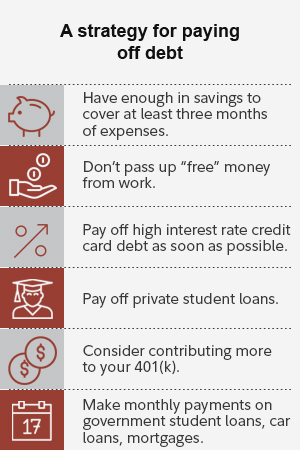
How to Pay Off Debt—and Save, Too

How to pay off debt

1.Set aside money for an emergency.

2.Don't pass up "free" money at work.

3.Pay this debt down first: high-interest credit card balances.

Paying extra can make a difference

4.Pay this debt down next: private student loans.

5.Contributing beyond the employer match in a 401(k).

6.Pay monthly minimum on government student loans, car loans, mortgages.


How to Pay Off Debt & Save, Too 

Monday, March 20, 2017

Vantage Point UPDATE: Intermediate-Term and Long-Term Trend Analysis


On
Friday, March 17, the S&P 500 closed @ 2378, and that was...
  
   +7.3% ABOVE its 12-Month moving average which stood @ 2217.
   +7.8% ABOVE its 40-Week moving average which stood @ 2207.
   +2.0% ABOVE its 10-Week moving average which stood @ 2331.


Therefore, the INTERMEDIATE-Term trend is BULLISH
and the LONG-Term trend is BULLISH.


Monday, March 13, 2017

Vantage Point UPDATE: Intermediate-Term and Long-Term Trend Analysis


On
Friday, March 10, the S&P 500 closed @ 2373, and that was...
  
   +7.1% ABOVE its 12-Month moving average which stood @ 2216.
   +7.7% ABOVE its 40-Week moving average which stood @ 2202.
   +2.2% ABOVE its 10-Week moving average which stood @ 2321.


Therefore, the INTERMEDIATE-Term trend is BULLISH
and the LONG-Term trend is BULLISH.