Showing posts with label risk. Show all posts

Wednesday, April 13, 2016

Finding The Right Retirement Portfolio Risk: 4 Sample Portfolios


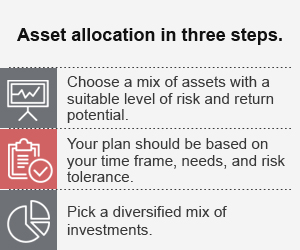
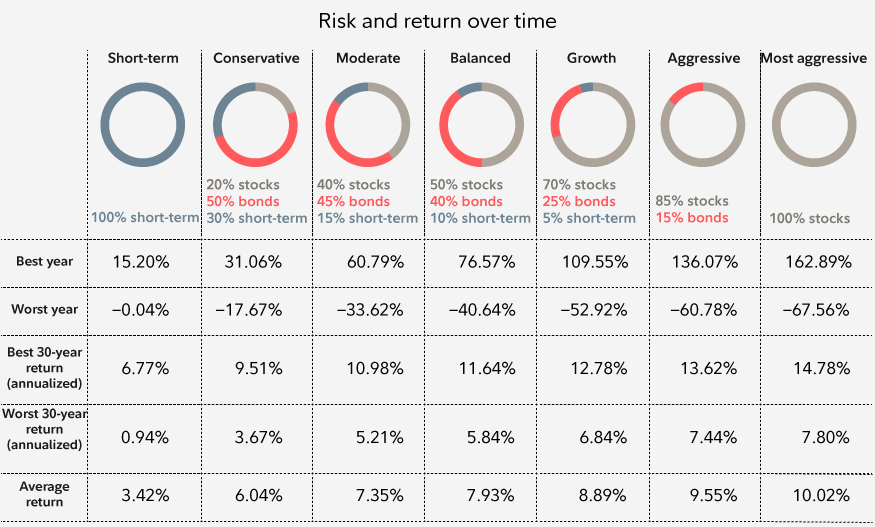
The sample target investment mixes below show a blend of stocks, bonds, and short-term investments with different levels of risk and growth potential. With retirement likely to span 30 years or so, you’ll want to find a balance between risk and growth potential.

Friday, September 19, 2014

The Top 10 Retirement Challenges: #3. Balancing Risk & Return


Balancing Risk and Return
Developing a proper asset allocation in a portfolio requires balancing many factors including risk tolerance, cash flow needs, time horizon and return requirements.

Planners want to reduce risk as much as possible in the portfolio while still achieving a sufficient return to achieve the client's financial goals -- an even more challenging task in light of current low interest rates on cash and bonds.

Thursday, August 25, 2011

Why Capital Preservation Is Paramount In This Climate...


One of our key indicators turned bearish for stocks in August.

When the 50-day BLUE moving average, is ABOVE the 100-day RED moving average, stocks are in an uptrend and stock market risk is below average.

When the 50-day BLUE moving average, is BELOW the 100-day RED moving average, stocks are in an downtrend and stock market risk is above average.

In the 2nd week of August, the 50-day BLUE moving average, crossed BELOW the 100-day RED moving average, increasing the odds that a new bear market may be at hand.

As a result, we have significantly reduced our stock market exposure in our managed accounts.

Until the
S&P 500's 50-day BLUE moving average crosses ABOVE the 100-day RED moving average again, we will maintain a defensive posture, largely in cash.

Risk is too high and the odds of a severe market decline are too great to do otherwise.


John Harris

Friday, April 1, 2011

Small-Cap & Mid-Cap Stocks Post New Recovery Highs!


On Friday April 1st, small-cap and mid-cap stocks (not shown) posted new weekly bull market recovery highs.

When these two sectors lead the market higher, it's been a bullish omen, historically.


In addition, downside stock market risk has been below average and upside potential has been above average in similar historical climates.


Friday, September 10, 2010

4 MORE Reasons Why Cash-Value Life Insurance Is Such A Valuable Financial Tool...

Here are four more (see yesterday's post) reasons to own cash-value life insurance:


1. It’s discounted estate tax insurance. Federal estate tax returns on January 1, 2011, because of sunset provisions in previous legislation. The exclusion returns to $1 million, and the maximum rate increases to 55%. Americans who were not subject to the tax now could be. Do you want to pay these taxes with whole dollars, or would you prefer a discount instead, using pennies to buy dollars? The answer is obvious: Life insurance provides that discount.

2. It’s a fully funded contractual will. Regular wills have many inadequacies. Even when they work, they proceed through probate, incurring costs and opening your affairs to the scrutiny of the public. When wills don’t work, your desires can be contested, at great cost, and can even be declared invalid. Life insurance “wills” have none of these problems and even fully fund your estate for the determined value at the precise time it is needed.

3. Life insurance pays what someone else would have to pay. Someone always pays for life insurance. The head of the family, if insurable, pays for their life insurance with a few dollars from their income. If they do not, and they die too soon, then someone else -- a widow, an orphan or a business -- inevitably ends up paying costs that would have been covered by life insurance. Ask yourself, “Do you want to make a big mistake or a little mistake?” The premium is the little mistake. Putting your family or business in jeopardy by dying without life insurance is the big mistake.

4. It’s transferred risk. Many fathers have daughters who are married to inadequately insured husbands. Who does the risk transfer to if the husband dies prematurely? Answer: The father (and loving grandfather). One solution: Insure the son-in-law. Have the cash value belong to the grandfather, and the death benefit belong to the daughter. Now the risk has been transferred.

Monday, August 30, 2010

Why Market Risk May Be Higher Than You Think: Reason #1 of 5...

1. The stock market is already expensive. 

Stocks are about 20 times cyclically-adjusted earnings, according to data compiled by Yale University economics professor Robert Shiller. That's well above average, which, historically, has been about 16. This ratio has been a powerful predictor of long-term returns. Valuation is by far the most important issue for investors.


Thursday, April 22, 2010

Historically Bullish Indicator Flashes A Buy Signal

A rare stock market BUY signal that was generated a couple of weeks ago by a trend-following indicator with an exceptional long-term record.

Prior to the recent buy signal, there had been only 12 since 1967.

And 2 of those 12 prior BUY signals occurred in the last 12 months alone. In other words, between 1967 and March 2009, this indicator gave just 10 BUY signals -- an average of just 1 every 4.3 years.

Since March 2009, though, they have averaged 1 every 4 months or so.

The indicator in question comes from Ned Davis Research, the quantitative research firm. It generates a buy signal whenever the percentage of common stocks trading above their 50-day moving averages rises above 90%.

Mr. Davis refers to such events as a "Breadth Thrust."


The recent BUY signal, according to this indicator, occurred on April 5. The other BUY signals over the last year occurred on May 4 and September 16 of last year.

How has the stock market performed following past BUY signals?

Quite well, according to Mr. Davis's calculations...


Bottom Line: 

If history is any guide, the current climate is a low-risk, high-reward environment.