Showing posts with label Roth. Show all posts

Wednesday, February 15, 2017

How Medicare Taxes Impact Upper-Income People


When you hear "Medicare Taxes," you probably don’t think about your investments. 

But these taxes affect many upper-income Americans with higher taxes on both wages and investment income. All the more reason to have a tax-smart financial plan in place.

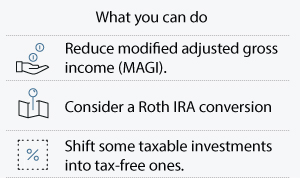
What you can do

There are TWO ways the Medicare Taxes affect upper-income people. 

First, a 3.8% Medicare surtax is levied on the lesser of net investment income or the excess of modified adjusted gross income (MAGI) above $200,000 for individuals, $250,000 for couples filing jointly, and $125,000 for spouses filing separately. 

Second, wages above $200,000 (individuals), $250,000 (joint filers), and $125,000 (spouses filing separately) will be subject to higher payroll taxes. 


Friday, February 10, 2017

Case Study: Managing Taxation on Retirement Income Withdrawals

Example: How to Manage Taxes on Withdrawals for Retirement Accounts.

How to manage taxes on withdrawals for retirement accounts
This hypothetical example is for illustrative purposes only. This hypothetical scenario assumed the couple does not receive Social Security benefits. Social Security income would further complicate the tax scenario described above and should be considered when creating a withdrawal strategy.
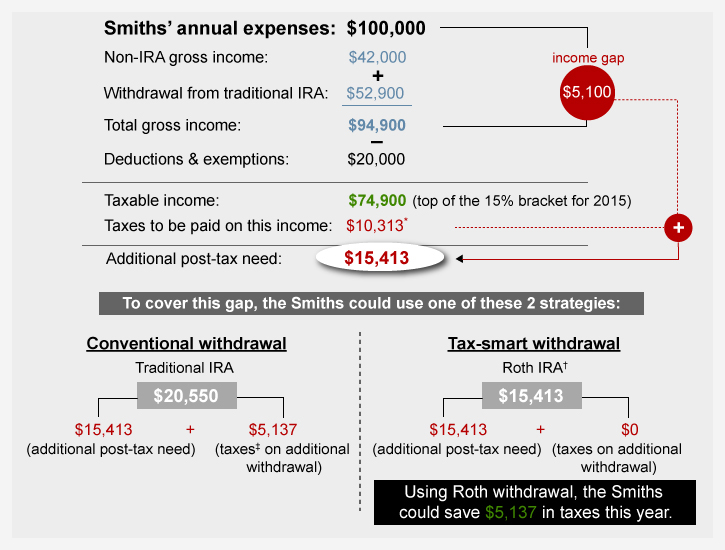
As a way to help minimize the taxes you’ll pay, consider the following hypothetical scenario. It illustrates the way a retired married couple whose annual expenses total $100,000 might seek to manage their taxes.

Our hypothetical couple expects $42,000 in gross income (all taxable) before tapping their retirement accounts, so their gross income gap—(before considering taxes)—is $58,000. They anticipate $20,000 in deductions and exemptions, so their expected taxable income before withdrawals is $22,000. If they withdraw $52,900 from their traditional IRAs, it would bring their taxable income to $74,900—the top of the 15% bracket. They could then withdraw the remaining $5,100 that they need to cover their income gap from a Roth IRA, which does not generate taxable income (assuming the withdrawal is qualified). The chart (above) shows their cash flow and taxable income.


Other Options for Our Hypothetical Couple


The hypothetical couple in this scenario leaves the bulk of Roth IRA assets alone, leaving them in place to potentially generate tax-free growth. In certain situations, however, it may be advantageous to tap Roth assets instead of tax-deferred or taxable accounts. These include situations when:
  • Any distributions at all from a tax-deferred account would cause your taxable income to exceed your target marginal tax rate
  • Withdrawing from a taxable account would require selling assets held less than a year, resulting in short-term capital gains, which are taxed at ordinary income tax rates
  • You are also trying to minimize taxes on Social Security benefits, withdrawals from a tax-deferred account would have an impact on the taxability of those benefits
Your circumstances may be considerably different from those described in the scenario. Nevertheless, you may be able to apply the principles to your own situation. A tax professional can help you explore the implications of different withdrawal strategies, help minimize the amount of taxes you pay on hard-earned savings, and, of course, help you maximize your ability to live the retirement you envision.

Wednesday, May 12, 2010

Who Are The Best Candidates For Roth IRA Conversions?

People with the largest IRAs are probably the best candidates for a conversion.

If they have the money to cover the initial tax implications — and they don’t need the money for a long time — that makes them an ideal candidate.


Not so much age. Someone in their 70’s or 80’s isn’t converting for himself because the life expectancy [on the Roth distribution] isn’t worth it.


It’s a great way to transfer wealth, especially if the client doesn’t need the money. High-income clients who didn’t qualify for this before are looking for this kind of thing.

Ed Slott, CPA

Tuesday, May 11, 2010

Will A Roth IRA Conversion Lower Estate Taxes?

Conversion won't lower estate taxes per se (although the fact that you prepaid the government taxes will make your estate value marginally lower), but it will lower the amount of ordinary income taxes beneficiaries would have to pay.

For example, if you have a $1 million regular IRA inheritance with no cost basis, the beneficiaries will owe income taxes on the entire $1 million.

If you converted to a Roth and paid $380,000 or so to do so out of taxable assets, the beneficiaries wouldn't owe income taxes on the $1 million, but of course the taxable assets used to pay for the conversion (which would have received a stepped up basis) would reduce the value of the other taxable assets they would have received.

It depends on the tax rates of beneficiaries, if they can use averaging to spread out the tax bite, etc.

David Loeper


Tuesday, March 16, 2010

5 Reasons to Roll a 401(k) into an IRA


Why would a 401(k) participant want to move his money out of a 401(k) and roll it into an IRA? Here are reasons why:


1. Most 401(k) s and other company plans have limited investment options. They may offer 50 different mutual funds and other investments options, but most of the options are subject to market fluctuations. If we learned anything in 2008 and early 2009, it’s that what the market gives can be taken away with little to no warning. Many of these accounts lost as much as -40% in 2008 alone. Those who chose to play it safe and moved their 401(k) money into bond funds or funds invested in CDs and other short-term investments were rewarded with little or no growth while inflation and management fees ate away at their principal. IRAs have almost unlimited investment options including annuities that guarantee the principal and offer a competitive rate of return.


2. Plan guidelines can restrict the owner’s access to his money. The plan document is essentially the 401(k) rulebook. If it’s not in the book, you can’t do it! With savings down and unemployment up, you never know when you may need access to your retirement accounts. IRAs offer greater flexibility, allowing the owners to make their own rules if they are willing to pay the tax on the distributions.


3. Direct rollovers avoid the 20 percent mandatory withholding. It’s critical that the funds are moved as a trustee-to-trustee transfer. If a check is written to the 401(k) owner, you can count on the custodian withholding 20% for the IRS. I have worked with several advisors who have encountered this problem, and they are still battling with the IRS to get the 20% withholding back where it belongs.


4. 401(k) s have limited distribution flexibility for the children and grandchildren who are likely to inherit when both the owner and spouse are gone. In 2002 when the multi-generational/“stretch” IRA was born, the children and grandchildren were given new valuable distribution options. They now have the right to spread the inherited IRA distributions over their individual life expectancies, according to Appendix C, Table 1 of IRS Publication 590. This means they are no longer forced into rapid distribution, causing rapid taxation. The 401(k) plan administrators didn’t get on board with this valuable income planning tool and are, in many cases, forcing these non-spousal beneficiaries to take full taxable distribution in just five years. Under the “Worker, Retiree and Employer Recovery Act” of 2008 (HR 7327), all employer plans will be required to allow non-spousal beneficiaries to do direct rollovers to properly titled inherited IRAs beginning January 1, 2010. IRAs allow these beneficiaries to take control and choose between cashing out and receiving a lifetime of income.


5. Most 401(k) plans do not allow the Roth IRA conversion. Beginning this year IRA owners with adjusted gross incomes over $100,000 can for the first time convert their traditional IRAs to Roth IRAs. After the conversion tax is paid, the new Roth will grow tax-free and distributions after the 5-year holding will also be income tax free. The Pension Protection Act simplified Roth conversions from 401(k) s and other company sponsored plans. Beginning in 2008, owners can convert company sponsored plan funds directly to a Roth IRA. They no longer need to convert to a traditional IRA first then convert the traditional IRA to a Roth IRA.

Friday, January 8, 2010

6 Roth IRA Conversion Mistakes & How To Avoid Them


There are plenty of reasons you may be interested in converting your Traditional IRA to a Roth IRA. Higher-income investors IRA investors are no longer excluded from converting their accounts, and income taxes due on the conversion can be spread over two years.


There are several missteps, however, that could derail a successful conversion.

Robert Powell, writing for MarketWatch.com, describes 6 mistakes to avoid when converting a Traditional IRA to a Roth IRA.

1. Neglecting to do the conversion. Powell cites Beverly DeVeny, an IRA technical consultant with Ed Slott and Company LLC, who asks, "Why would you not want to pay taxes today at known -- probably very low rates -- to get tax-free income at a later date (probably at higher and maybe much higher rates)?” She recommends investors who don’t want to convert their entire IRA at once at least convert a portion of it.

2. Failing to understand tax consequences. Powell calls Roth IRAs the opposite of traditional IRAs. The Roth IRA is funded with after-tax dollars, and distributions aren’t taxed; the traditional IRA uses pre-tax dollars and distributions are taxed. “The additional income from the distribution of the traditional IRA would most likely bump you into a higher tax bracket,” he writes.

3. Converting when you are likely to be in a lower tax bracket. If it’s likely that you will slip into a lower tax bracket, you should hold onto your traditional IRAs.

4. Having taxes owed withheld from the transaction. Powell turns to Denise Appleby, chief executive of Appleby Retirement Consulting, who warns against withholding taxes from a conversion. The amount withheld reduces the conversion amount, and is subject to the 10% early distribution penalty, unless you are older than 59 ½ when you convert the accounts. Furthermore, if you decide later that they want to reverse the conversion, you can only reverse what was originally credited to the new Roth IRA. If anything was withheld for taxes, that portion would be taxed as a distribution from a traditional IRA.

5. Converting to just one Roth IRA. Powell suggests that investors convert traditional IRAs into as many Roth IRA accounts as possible, with investments of a similar type. “With Roth IRA conversions,” he writes, “Uncle Sam lets you switch back to a traditional IRA before a certain date should the value of the account fall below the original conversion amount.”

6. Forgetting to consider a recharacterization. If the value of the converted Roth IRA falls significantly, you have some tax-saving opportunities if you undo the conversion. Income tax is owed on the entire pre-tax amount that was converted, even if the market value falls below the original amount.

"The good news is that taxable conversion transaction can be reversed (recharacterized), if it is done by your tax filing deadline, including applicable extensions,” according to Appleby.

“The recharacterization can be done, even if your tax return has already been filed, as an amended tax return can be filed to reflect the removal of the conversion from the individual's taxable income.”

Monday, January 4, 2010

Q&A: How to Prepare for a Slow Roth IRA Conversion @ WSJ.com

Ask Encore @ WSJ.com
Focus on Retirement - By KELLY GREENE


Q: I'm 60 years old and plan on converting portions of my IRA to a Roth yearly, over the next 10 years. My question is: Should I convert the winners or losers first?

—Karen Quandt, Maryville, TN

A: When considering converting investments to a Roth IRA from a traditional individual retirement account, past performance is less important than what you anticipate in the future.


"I would say to convert the losers, if you expect them to become winners, and focus first on the ones you think are going to appreciate the fastest," says Ed Slott, an IRA consultant in Rockville Centre, N.Y.


First, the basics: Starting January 1, 2010, the $100,000 income limit disappears for converting traditional IRAs and employer-sponsored retirement plans to Roth IRAs. Although the conversion is subject to income tax, future withdrawals (that meet holding requirements) would be tax free.

With that in mind, let's go back to your winners-and-losers strategy: If you hold an investment with appreciation potential, or that you consider beaten down or depressed in value, it makes sense to convert it to a Roth, Mr. Slott says. That way, you won't have to pay tax on any increase in value.

Conversely, if you are holding an investment at or near an all-time high, such as a stock you bought for $20 that has climbed to $100, "that may not be the one to convert," he says.

You also might consider opening a separate Roth for each type of investment you make with the converted investments. That way, you could cherry-pick the so-called losers by "recharacterizing" any Roth IRA investments that lose value, Mr. Slott says. Even if your predictions turn out wrong, and the converted Roth assets fall in value, you are allowed to recharacterize the account as a traditional IRA and no longer owe the tax.

For example, let's say you made two types of investments, one that doubled in value and another that lost everything. If those investments were in the same Roth, the account value would appear unchanged. But if they were in separate accounts, you could recharacterize the one that suffered—and allow the one doing well to continue appreciating in value as a Roth.

(The deadline for recharacterizing IRA assets converted to a Roth in 2010 is October 15, 2011.)

One other note: As our reader recognizes, a Roth conversion isn't an all-or-nothing option.

One way to mitigate the tax-bill pain is to do incremental conversions across a number of years.

You might even want to get your accountant to help you figure out how much you could convert within your current tax bracket each year without bumping yourself into a higher one.


Write to Ask Encore at encore@wsj.com

Tuesday, December 15, 2009

WSJ: Why It May Pay To Convert to a Roth IRA

By KELLY GREENE
[ROTHTAX]

Investors and financial advisers are preparing to take advantage of a new tax law that makes it easier to gain access to Roth IRAs—even if it means breaking a sacrosanct rule about Roth conversions.

Starting, January 1, the $100,000 income limit disappears for converting traditional individual retirement accounts and employer-sponsored retirement plans to Roth IRAs, one of the biggest changes on the IRA landscape in years. Roths, of course, have long been viewed as one of the best deals in retirement planning; after investors meet holding requirements, virtually all withdrawals are tax-free.

How many investors will make the leap is unclear. Converting to a Roth can be expensive; it requires paying income tax on all pretax contributions and earnings included in the amount converted. What's more, financial advisers have long argued that converting makes sense only if an investor can pay the tax from funds outside the IRA itself - an admonition that seemingly limits the strategy to the very wealthy.

That said, some financial advisers say growing numbers of their clients are leaning toward a Roth conversion, even if they have to tap their traditional IRAs to pay the taxes. The primary reasons: new, contrarian analyses of taxes and conversions—and a desire to gain more control over nest eggs in the years ahead. With a traditional IRA, investors must begin tapping their accounts after reaching age 70 1/2, which increases taxable income. With a Roth, there are no required distributions, giving retirees more flexibility in managing their investments and cash flow.

For many investors, "the required minimum distribution makes them sick," says John Neyland, president of JCN Financial Group in Baton Rouge, La. "They don't want the government to tell them when to take the money out."

Although only 5% of the country's $3.7 trillion IRA assets currently are held in Roths, about 13 million households holding more than $1.4 trillion in retirement assets will become newly eligible next month for conversions, says Ben Norquist, president of Convergent Retirement Plan Solutions LLC, a Brainerd, Minn., consulting firm. Vanguard Group predicts that 5% of its customers will do Roth conversions in 2010, up from a typical 1.5% rate. Charles Schwab & Co. found that 13% of 400 households with adjusted $100,000-plus incomes are considering converting at least part of their IRAs.

The income tax due on assets being moved to a Roth from a traditional IRA is a non-starter for many people, because few—including those with incomes of $100,000 or more—have the assets outside their tax-deferred accounts to pay the Internal Revenue Service. Others, who do have the money, are reluctant to part with it; such funds, often, are set aside for emergencies.

But some financial planners, after running projections involving retirement savings, withdrawals and taxes in coming decades, have concluded that it's worthwhile for many in this group to convert at least some of their IRA assets to a Roth—and pay the tax with funds inside the IRA.

"I have a case where my client is 60, and I was surprised to find that she comes out ahead whether she pays the tax with cash \[outside the IRA\] or the assets inside the IRA," says Deborah Linscott, a financial adviser in Dublin, Ohio.

Here's why: Even though individuals who convert and who decide to pay the tax bill with funds inside their IRA are lowering their overall IRA balance, their new Roth account eliminates the requirement to make taxable withdrawals after age 70 1/2. For some people, that means they can stay below the threshold at which much of their Social Security checks would be taxed. Others can avoid higher Medicare premiums (which are tied to income levels). And a few could wind up leaving larger legacies down the road, since inherited Roth IRAs aren't subject to income tax, either.

Bob Phillips, a 64-year-old retired engineer in suburban Cleveland, plans to covert his traditional IRA valued at $552,000 to a Roth. He has only about $8,000 in cash, so he plans to pay the tax from his IRA assets, which will reduce his retirement savings. But when Mr. Phillips turns 70 1/2, he won't have to make any taxable withdrawals, meaning the $35,000 in Social Security benefits that he and his wife receive annually shouldn't become taxable.

If the Phillipses can avoid losing about 20% of their Social Security to taxes, their Roth withdrawals—should they need them—will be smaller, as well. That, in turn, gives the Roth a better chance to grow with time, says Mark Tepper, the couple's investment adviser.

Mr. Tepper used 10,000 "Monte Carlo" simulations (designed to estimate the odds of reaching financial goals) and found that, without doing a Roth conversion, they have only a 50-50 chance of making their funds last across their life expectancies. With a Roth conversion, even using assets from the account itself to pay the tax, they have an 88% chance of not outliving their savings.

Some additional points to consider:

— Investors weighing Roth conversions may want to run their plans by a local accountant: At least one state, Wisconsin, didn't drop the $100,000 income limit, meaning unwitting residents over that limit face a penalty for Roth conversions.

— IRA owners with Medicare Part B who convert to a Roth may subject themselves for a year or two to higher premiums (which, again, are tied to income).

— Investors under age 59 1/2 who convert to a Roth would pay an early-withdrawal penalty on IRA assets used to pay tax.

— Using IRA assets to pay the tax man reduces the amount you could later "recharacterize": If the converted Roth assets fall in value, you are allowed to recharacterize the account as a traditional IRA and no longer owe the tax. "But if you take $100,000 out of your IRA and you only roll $80,000 into a Roth, you only have $80,000 to recharacterize, not the whole thing," says Ed Slott, an IRA consultant in Rockville Centre, N.Y.

—Anne Tergesen contributed to this article.

Write to Kelly Greene at kelly.greene@wsj.com

Sunday, December 6, 2009

Q&A: Paying Taxes After a Roth IRA Conversion - Ask Encore @ WSJ.com

Ask Encore @ WSJ.com 
Focus on Retirement - By KELLY GREENE

Q: In 2010, when the income limits are lifted for converting a traditional IRA to a Roth IRA, my wife and I plan to convert about $50,000 in traditional IRAs. We plan to pay the taxes with funds from outside the IRA and also to pay them all in the 2010 tax year.

Our question is this: At what time during the 2010 tax year are the taxes due? For example, if we convert in January 2010, do we need to pay estimated taxes for first quarter of 2010 by April 15, 2010? Or can we wait to pay the taxes until we file our 2010 taxes in March or April of 2011—without incurring a penalty for being "under-withheld"?

If we would need to pay quarterly estimated taxes, it would probably cause us to defer the conversion until the fourth quarter of 2010, and thus not owe the taxes until 2011.


—Paul Sklar Pittsburgh, PA

A: You're ahead of the game, because many people have no idea that converting assets to a Roth IRA could affect the timing of their tax payments.

To review: Effective Jan. 1, 2010, the federal government is permanently dropping the income limit for transferring savings to a Roth IRA from a traditional individual retirement account or employer-sponsored retirement plan. Although such conversions will be subject to income tax, future withdrawals (that meet holding requirements) would be tax-free.


One important thing to think about in terms of timing: Delaying a Roth conversion until the fourth quarter of next year might help you delay paying the tax involved; but if your IRA has fallen in value in the past few years, you may want to convert the account as soon as possible next year, before its value recovers further, to keep the tax bill as low as you can.

"What have you accomplished if the value of the IRA goes up in that time and you pay tax on it?" says Barry Picker, a certified financial planner and certified public accountant in New York. "It could have been in a Roth growing tax-free."

Adds Lester Law, national wealth strategist for U.S. Trust, Bank of America Private Wealth Management: "This is not a tax payment decision; it's an investment and estate-planning decision. Don't let the tax tail wag the dog."

Generally, you have three options for paying income tax throughout the year, and thus avoiding a penalty and interest for underpayment of your income tax.

  1. The first is to pay 100% of last year's tax, or 110% of last year's tax if your adjusted gross income is over $150,000 for individuals or for married couples who file joint tax returns. This method is the one most commonly used and it will probably work for most people who plan to pay any income tax for a 2010 Roth conversion as part of their 2010 tax return, Mr. Law says.

  2. The second option is to pay 90% of the current year's tax, which is something that people who convert a large amount to a Roth in 2010 may want to consider doing in 2011 as a way to lower the tax amounts that they pay quarterly or have withheld from their paychecks, he says.

  3. The third option is to estimate your income each quarter and pay tax on it for that quarter, Mr. Law says.
As for the mechanics of actually making the payments: You can have the tax withheld from your paycheck; you can make quarterly payments (actually due April 15, June 15, Sept. 15 and Jan. 15); or you can do a combination of both, Mr. Law says.

One Other Note: Conversion income might drive up your state income taxes as well. To get a definitive answer for a specific state or local government, you should check with a local accountant.

Write to Ask Encore at encore@wsj.com

Sunday, November 29, 2009

Q&A: Nuts and Bolts of Five-Year Rule on Roth IRAs - WSJ.com

Ask Encore @ WSJ.com
Focus on Retirement - By KELLY GREENE

Q: Could you explain how the five-year rule for Roth IRA conversions works and how it differs from the five-year rule for contributions to Roths?

Do multiple conversions over a period of time trigger a new five-year waiting period for each conversion?

Does attaining age 59½ have an effect?


—Stephen Turbin, North Miami, Fla.

A: For withdrawals to be penalty free, the five-year rule governing Roth IRAs for the most part works the same for people who open and begin periodic contributions to a Roth IRA and those who convert to a Roth from a traditional individual retirement account or other retirement plan. But as with all things involving IRAs, there is a wrinkle or two.

Let's start with the person who opens a Roth and makes periodic contributions. That person can withdraw those original contributions anytime with no tax or penalty. The five-year clock for earnings on those contributions starts January 1 of the year for which your first Roth contribution was made, and it doesn't reset each time you make a contribution or open another Roth. You have to turn 59½ to avoid a 10% penalty for early withdrawals on any earnings, and also to avoid income tax on those earnings.

As for the person who converts to a Roth: In a conversion, you have to hold the assets in a Roth for five years or until turning 59½, whichever comes first, to make penalty-free withdrawals of your converted amounts. Here, each conversion has its own five-year clock.

If you already are 59½ and you convert traditional IRA assets to a Roth, you can withdraw the assets you convert at any time without worrying about a five-year deadline or penalties.

Again, it is a different story with any earnings on those assets: You have to have held a Roth account for five years to withdraw any earnings tax free. But you generally don't need to worry about separating the converted funds from the earnings, since the withdrawal rules for Roth IRAs say that any distributions first come from contributions, then from conversions, and finally from earnings, says Ed Slott, an IRA consultant in Rockville Centre, N.Y.

Rules are spelled out in IRS Publication 590, "Individual Retirement Arrangements," at http://www.irs.gov/. See page 69 under "Ordering Rules for Distributions."

Let's say that 10 years ago, you put $100 into a Roth IRA and now you are 62. That means you have met the age requirement and the five-year-holding requirement for withdrawing your contribution and any earnings with no penalty or tax, Mr. Slott says.

Now, let's say you still have that $100 Roth, and you also convert $100,000 from a traditional IRA to a Roth. (Of course, you pay taxes on the conversion.) You could then withdraw the $100,000 with no tax or penalty, because it is considered to have been held for five years, Mr. Slott says. "The five-year period started the first day you opened that Roth IRA 10 years ago, so you could take out that $100,000 any time."

If you are younger than 59½, though, you could run into trouble: Let's say you're 40 and you opened a Roth 10 years ago with $100. Now you convert $100,000 to a Roth IRA. If you withdraw that $100,000 a year later, at age 41, you owe a 10% penalty on all the converted funds. Even though the account has been open five years, each conversion starts a five-year clock -- until you turn 59½. (You wouldn't owe tax on that amount, though, because it is generally due for the year of the conversion.)

Write to Kelly Greene at kelly.greene@wsj.com

www.WSJ.com