Showing posts with label IRA. Show all posts

Friday, March 10, 2017

Assessing 401k Fees and Rollover Options


401k Fees and Rollover Options


401k Fees could erode your retirement savings as much as -30% over time. 

Understanding the fees associated with your retirement accounts is typically very difficult.

But, if you don’t know or understand how much you’re paying in fees associated with different investment options, how can you know if you’re overpaying for certain funds and limiting retirement balances from increasing more fully?

Phyllis Borgi, the Assistant Secretary of Labor for Employee Benefits Security, said that she was troubled by the complex fee disclosure format that some companies have put out.

Some companies have tried to hide, confuse, or be very non-specific in their disclosure of these fees.

The U.S. Department of Labor reports 401k accounts typically charge fees of 1%–2% for administration and management fees. These fees are deducted from your retirement savings every year on the full value of your account even if your account loses value. 

Fees of 1%-2% may seem trivial, but over 20-30 years - even at just 1% - this means 20%-30% less money at retirement, and 20%-30% less income at retirement.

This could cost you hundreds of dollars each month for the rest of your life.

401k Rollover to a Self-Directed IRA may be an option for you, even if you are still employed with the company. 

If you are aged 59½ or older and looking to keep your retirement savings in a safe and secure, contractually guaranteed account, a fixed-indexed annuity could be a viable option.


Friday, February 10, 2017

Case Study: Managing Taxation on Retirement Income Withdrawals

Example: How to Manage Taxes on Withdrawals for Retirement Accounts.

How to manage taxes on withdrawals for retirement accounts
This hypothetical example is for illustrative purposes only. This hypothetical scenario assumed the couple does not receive Social Security benefits. Social Security income would further complicate the tax scenario described above and should be considered when creating a withdrawal strategy.
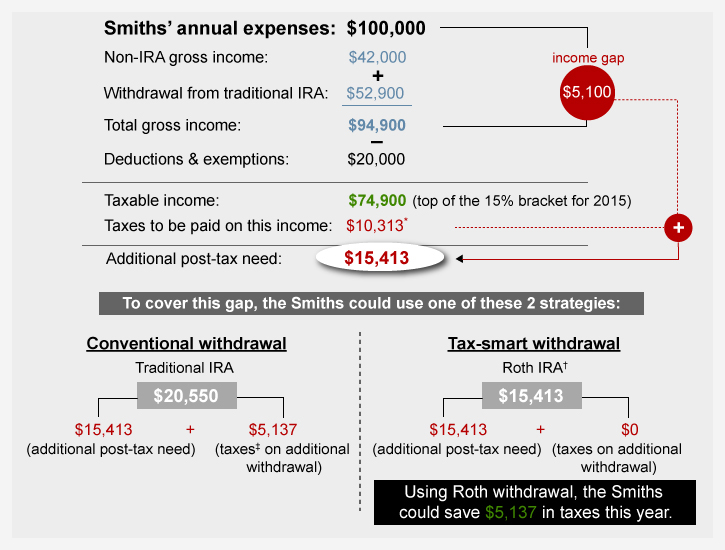
As a way to help minimize the taxes you’ll pay, consider the following hypothetical scenario. It illustrates the way a retired married couple whose annual expenses total $100,000 might seek to manage their taxes.

Our hypothetical couple expects $42,000 in gross income (all taxable) before tapping their retirement accounts, so their gross income gap—(before considering taxes)—is $58,000. They anticipate $20,000 in deductions and exemptions, so their expected taxable income before withdrawals is $22,000. If they withdraw $52,900 from their traditional IRAs, it would bring their taxable income to $74,900—the top of the 15% bracket. They could then withdraw the remaining $5,100 that they need to cover their income gap from a Roth IRA, which does not generate taxable income (assuming the withdrawal is qualified). The chart (above) shows their cash flow and taxable income.


Other Options for Our Hypothetical Couple


The hypothetical couple in this scenario leaves the bulk of Roth IRA assets alone, leaving them in place to potentially generate tax-free growth. In certain situations, however, it may be advantageous to tap Roth assets instead of tax-deferred or taxable accounts. These include situations when:
  • Any distributions at all from a tax-deferred account would cause your taxable income to exceed your target marginal tax rate
  • Withdrawing from a taxable account would require selling assets held less than a year, resulting in short-term capital gains, which are taxed at ordinary income tax rates
  • You are also trying to minimize taxes on Social Security benefits, withdrawals from a tax-deferred account would have an impact on the taxability of those benefits
Your circumstances may be considerably different from those described in the scenario. Nevertheless, you may be able to apply the principles to your own situation. A tax professional can help you explore the implications of different withdrawal strategies, help minimize the amount of taxes you pay on hard-earned savings, and, of course, help you maximize your ability to live the retirement you envision.

Tuesday, February 5, 2013

10 Biggest Retirement Mistakes: #2. Taking A 401(k) Check


If you decide to transfer your 401(k) or other retirement assets to an IRA, make sure they go directly to the new custodian.

If your employer cuts you a check, the company will be required to withhold 20% for taxes and you will have to roll the entire amount — including the 20% you didn't receive — into an IRA within 60 days.

Any money not deposited into the IRA would be treated as a taxable distribution, subject to taxes and early-withdrawal penalties.


Thursday, January 31, 2013

10 Biggest Retirement Mistakes: #4. Mishandling Company Stock


Rolling your 401(k) into an IRA is generally a good idea, but it may not be the right decision when you own highly appreciated company stock inside your plan.

A special rule for what is called “net unrealized appreciation” allows you to move your employer’s stock out of your 401(k) when you retire or leave your job.

You must follow the rules precisely to take advantage of lower capital gains rates, rather than ordinary income taxes, when you sell the stock.


Wednesday, November 14, 2012

10 Biggest Retirement Mistakes: #6. Tapping Retirement Accounts Too Soon


If you tap your retirement funds before age 59 1/2, you'll owe 
a -10% early-withdrawal penalty on top of the federal and state income taxes you'll pay on each distribution.

But if you are at least 55 when you leave your job, you can take distributions from your 401(k) without paying a penalty (although you will still owe income taxes on your withdrawals).

If you transfer your funds to an IRA, you lose the “55-and-out” option.


Thursday, November 8, 2012

10 Biggest Retirement Mistakes: #7. Interrupting Early IRA Payouts


A way exists to avoid early withdrawal penalties if you tap your IRA before you are 59 ½.

You must take “substantially equal periodic payments" from your IRA based on your life expectancy for at least five years or until you are 59 1/2, whichever is longer.

But if you deviate from the payout schedule, you'll owe a 10% penalty retroactive to your first withdrawal, plus interest.


-

Tuesday, October 9, 2012

10 Biggest Retirement Mistakes: #9. Ignoring Minimum Distribution Rules


You are required to start withdrawing from your IRA by April 1 following the year you turn 70 1/2, and to take withdrawals by December 31 of that year and each year afterward. 
Miss the deadline and you’ll owe a tax penalty of 50% of the amount you failed to withdraw. You can skip the required distribution from your 401(k) is you are still working, but not your IRA.